


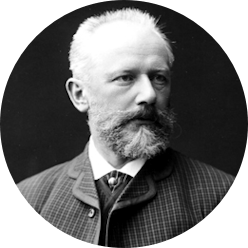
Pyotr Ilyich Tchaikovsky
May 7, 1840 - Votkinsk (Russia) — November 6, 1893 - St. Petersburg (Russia)
About
In the nineteenth century, a time of rising nationalism, composers heatedly debated how to forge national musical identities. Pyotr Ilyich Tchaikovsky rose to this challenge, blending Russian folk traditions with Western formal structures. Thanks to the generosity of an eccentric patron, he became Russia’s first professional, full-time composer. Today, Tchaikovsky remains the most popular of Russian composers: remembered for his passionate, late-Romantic symphonies and concertos; operas such as Eugene Onegin; and his three transcendent ballets. The cause of his early death remains a subject of controversy and conjecture.
Early years
A precocious talent
Pyotr Ilyich Tchaikovsky was born in 1840 in Votsinsk, an industrial town in the western half of the Russian Empire. His father was a mining engineer whose job forced the family to move frequently. Precocious and high-strung, Tchaikovsky read and wrote in French by the age of six (he also read German). He was particularly close with his mother and two of his younger siblings, his sister Aleksandra and his brother Modest.
Tchaikovsky’s father bought the family a mechanical organ; one of his fondest childhood memories involved repeatedly listening to Wolfgang Amadeus Mozart’s opera Don Giovanni on the organ. He retained a reverence for Mozart throughout his life. His family supported his interest in music, giving him piano lessons and private tutors. Still, his childhood was not without difficulty. Frequent moving left him unmoored and without friends. He survived both the measles and a cholera outbreak, though the latter claimed his mother’s life. It is around this time that he made one of his first serious attempts at composition, a short waltz.
Tchaikovsky spent most of his teenage years studying to become a civil servant at the School of Jurisprudence. There he maintained an active musical life, attending concerts and studying choral singing with Gavriil Lomakin. Outside school, he studied singing (with teacher Luigi Piccioli), piano (with Rudolf Kündinger), and opera while making additional fledgling attempts at composition.
First years of formal study
In 1861, Tchaikovsky took his first music theory courses. His teacher, Nikolay Zaremba, was a devotee of Ludwig van Beethoven’s late style. The following year, Tchaikovsky applied to the newly formed Saint Petersburg Conservatory. His principal teacher was Anton Rubinstein, who had co-founded the conservatory; Anton’s brother, the virtuoso pianist Nikolai Rubinstein, would also play a significant role in Tchaikovsky’s life.
Tchaikovsky’s student works reveal his quick maturation as a composer. These include a tone poem, The Storm (based on a Russian play of the same name), as well as a setting of Schiller’s “Ode to Joy,” the same text Beethoven adapted for the finale of his Symphony No. 9 in D Minor. Even as a student, he was grappling with questions of Russian musical identity versus Western training and techniques. Herman Laroche, a longstanding friend of Tchaikovsky’s, said to him, “You are the greatest musical talent in present-day Russia … I see in you the greatest, or, better said, the sole hope of our musical future.”
The mature composer
“The Five”
A group of young composers known as “the Five” and “the Mighty Handful” led the charge for a distinctly Russian identity in classical music. They sought to achieve their goal by incorporating Russian folk music, non-Western scales, and Orientalist themes (as in the tone poem Scheherazade) into their works. The Five were initially distant toward Tchaikovsky: they viewed conservatory training as the bane of originality and found his music “overly dependent on the West.” Despite somewhat different aesthetic aims, Tchaikovsky eventually befriended Mily Balakirev and Nikolai Rimsky-Korsakov, two members of the Five.
Teaching at the Moscow Conservatory
In 1866, the year following his graduation from the Saint Petersburg Conservatory, Tchaikovsky joined the founding faculty of the Moscow Conservatory. Nikolai Rubinstein, a founder of the Conservatory (and brother of Anton, Tchaikovsky’s teacher in Saint Petersburg), championed Tchaikovsky’s music, conducting the premieres of his first four symphonies as well as several of his tone poems. Nikolai’s death in 1881 would be a major psychological blow.
Near the end of his tenure, Tchaikovsky fell in love with one of his students, Iosef Kotek. Whether his feelings were reciprocated is unknown, though some assert that the pair were lovers. Kotek assisted in the composition of the Violin Concerto in D Major. The composer wanted to dedicate the work to his pupil but worried that doing so would spread gossip about his sexual orientation.
Always a poor manager of money, Tchaikovsky turned to side jobs to make ends meet. He spent nearly a decade writing music criticism while teaching and composing. He also translated works of literature and wrote arrangements of other composers’ pieces. By the end of the 1870s, however, he had won a new level of financial freedom under the auspices of a wealthy admirer.
Marriage and von Meck
The year 1877 was one of the most tumultuous in Tchaikovsky’s life, bringing both psychological devastation on the one hand and financial salvation on the other. That spring his first ballet, Swan Lake, premiered to lukewarm reception. Later that year he entered into a disastrous "lavender marriage.” He knew that being openly gay in imperial Russia would ruin his reputation, so he attempted to hide his orientation outside his close circle of friends (his younger brother Modest was more open about his sexuality). Tchaikovsky and his wife separated after two months, and he subsequently had a mental breakdown. This period coincided with the composition of his Symphony No. 4 in F Minor and his greatest opera, the doomed romance of Eugene Onegin.
As his marriage was crumbling, Tchaikovsky was establishing a personal and professional relationship with the eccentric businesswoman Nadezhda von Meck. The widow of a railroad magnate, she agreed to sponsor Tchaikovsky, sending him a monthly stipend. With this generous allowance he became Russia’s first full-time professional composer. He took a lengthy sabbatical from the Conservatory, eventually quitting to travel in solitude. Over the course of this thirteen-year arrangement, von Meck became one of Tchaikovsky’s closest confidantes despite her insistence that they never meet.
Growing success
Following years of increasingly successful premieres in Russia, Tchaikovsky built a growing audience in Europe and the United States. Nikolai Rubinstein and the German conductor and pianist Hans von Bülow were among the most notable champions of his work abroad. By the late 1880s Tchaikovsky had taken up conducting, which took him on several tours where he introduced his music to new audiences. He co-conducted the inaugural orchestral performance at Carnegie Hall in New York City, and received an honorary doctorate from Cambridge in his final year.
The final masterpieces
Tchaikovsky composed a succession of brilliant pieces in his last five years. Following the premiere of his Symphony No. 5 in E Minor, he returned to writing ballet after a decade-long hiatus. Sleeping Beauty premiered in early 1890; his opera The Queen of Spades premiered before the end of that same year. The success of Sleeping Beauty, his first collaboration with ballet master Marius Petipa, led to a second: The Nutcracker premiered in 1892 as a double bill with Tchaikovsky’s final opera, Iolanta. The next year saw the premiere of his tragic Symphony No. 6 in B minor; barely a week later, Tchaikovsky lay dead.
A shocking death foretold?
Tchaikovsky dedicated his Sixth Symphony, nicknamed Pathétique, to his nephew Vladimir. Nicknamed “Bob” by his family, Vladimir had long been an object of his uncle’s infatuation. Nine days after the symphony premiered, Tchaikovsky died. The cause of his death remains unknown, though hypotheses have ranged from sickness to forced suicide. The most widely accepted version of events has Tchaikovsky drinking unboiled water during a cholera epidemic. Many have speculated that the final symphony, premiered just before its composer’s demise and charged with great emotion, may be a sort of musical suicide note.
Tchaikovsky's music
The symphonies
The composition of Tchaikovsky’s six complete symphonies spans a period of over twenty-five years. Of these, all but one are in a minor key. He completed his Symphony No. 1 in G Minor, Winter Daydreams, around the time he joined the Moscow Conservatory, dedicating the work to Nikolai Rubinstein, who had offered him the post. As with many of his compositions, he incorporated Russian folksong into the symphony, part of a lifelong project to reconcile East and West.
Tchaikovsky maintained a lifelong sensitivity to criticism from both colleagues and critics. A consistent criticism of the symphonies was a perceived failure to master the sonata-allegro form codified by composers such as Haydn, Mozart, and Beethoven. If Tchaikovsky's bountiful gift for melody came at the expense of thematic development and structural coherence, it has not kept him out of the concert hall. His Fifth and Sixth Symphonies, both lauded for their feelings of intense emotional struggle, remain popular mainstays.
The operas
Only a few of Tchaikovsky’s ten completed operas remain in the repertoire. Of these, Eugene Onegin is by far the most performed. In this romantic drama based on Pushkin’s novel, tragedy ensues when the title character rejects the advances of a young woman. The opera’s composition overlapped with the crisis months of Tchaikovsky’s tumultuous marriage.
Tchaikovsky’s brother Modest penned the libretti for his last two operas, The Queen of Spades and Iolanta (Modest, who was also gay, wrote one of the earliest biographies of his brother). The scenario of the former, a three-act tragedy, turns on a hand of playing cards, a plot element similar to one of Tchaikovsky’s favorite operas, Carmen by Georges Bizet. Iolanta, which premiered as a double bill alongside The Nutcracker, has a much happier ending.
The concertos
Of the two piano concertos, the First remains a concert staple. Tchaikovsky wanted to dedicate the piece to his colleague Nikolai Rubinstein, but after Rubinstein’s unusually harsh criticism, Tchaikovsky asked Hans von Bülow to premiere it instead. Rubinstein eventually warmed to the concerto, performing it multiple times. Despite this initial reception, the Piano Concerto No. 1 is now among the best known of all piano concertos.
The Violin Concerto in D Major also premiered to lukewarm reception. One famously acerbic critic called the finale “odorously Russian,” but the composer had the last laugh. With its gorgeous cantabile melodies, virtuosic displays, and rich orchestration, the concerto has been recorded by the greatest violinists of the past century.
The ballets
Tchaikovsky’s three ballets—Swan Lake, The Sleeping Beauty, and The Nutcracker—form the cornerstone of not only Russian ballet but the entire genre. His first, Swan Lake, depicts the relationship between Prince Siegfried and Odette, the Swan Queen, as well as their struggle against the dark wizard Rothbart. Tchaikovsky’s inexperience writing for the medium sets Swan Lake apart: few other composers before him would have dared to compose such lush, rhythmically complex orchestral music for a ballet. The work became a classic following the premiere of choreographer Marius Petipa’s revival.
The Sleeping Beauty marked the start of what has been called “the greatest collaboration of [Tchaikovsky’s] career,” his partnership with Petipa. Petipa worked on both The Sleeping Beauty and Tchaikovsky’s final ballet, The Nutcracker. This perennial Christmas favorite has become an annual tradition around the world; for many, it is their introduction to ballet. Many of Tchaikovsky’s most recognizable themes, from the graceful “Waltz of the Flowers” to the tinkling “Dance of the Sugar Plum Fairy,” come from this work. The dazzling New York City Ballet production created by George Balanchine has become iconic in its own right.
Overtures and program music
Of Tchaikovsky’s numerous short symphonic works, two have made the jump to popular culture. The first of these, the Romeo and Juliet Overture, premiered in 1870. Its instantly recognizable love theme has been referenced and parodied in cartoons, films, and video games. The passionate melody may have been inspired by one of Tchaikovsky’s lost loves, a young man who took his own life.
The 1812 Overture commemorates the seventieth anniversary of Russia’s triumph over Napoleon Bonaparte. In a letter to Nadezhda von Meck, Tchaikovsky lamented that the piece was “probably lacking in artistic merit.” Misgivings aside, the overture is one of his most thrilling and well-known. It opens with a Russian hymn; later quotations of “La Marseillaise” and the Russian national anthem depict Russia beating back Napoleon’s forces. Its bombastic climax of cannons, pealing bells, and brass fanfare have made the 1812 Overture an enduring, celebratory classic.
Tchaikovsky’s influence on classical music
Since its premiere in 1954, Balanchine’s production of The Nutcracker has been performed in New York City every year except one. In his homeland, Tchaikovsky’s fusion of Western form and Russian folk music influenced generations of composers including Sergei Rachmaninov, Igor Stravinsky, Sergei Prokofiev, and Dmitri Shostakovich. For nearly fifty years, the Piano Concerto No. 1 has played at numerous Olympic Games, Tchaikovsky’s music chosen to represent Mother Russia herself.
Perhaps no composer since Beethoven has become more associated with the image of the tortured artist struggling against Fate. With its combination of pathos and tunefulness, his music fills concert halls and captures the popular imagination. Nearly two centuries after his birth, Tchaikovsky indisputably remains Russia’s most performed classical composer.
Pyotr Ilyich Tchaikovsky: timeline of key dates
- 1840: Pyotr Ilyich Tchaikovsky is born in Votkinsk, Russia.
- 1848: Revolutions spread across Europe, but these collective Revolutions of 1848 are quashed within two years. Karl Marx publishes the first edition of The Communist Manifesto.
- 1850: Tchaikovsky’s brother Modest is born. In adulthood, Modest writes the libretti for his brother’s operas The Queen of Spades and Iolanta.
- 1853: The Ottomans declare war on Russia, igniting the Crimean War.
- 1854: Tchaikovsky composes his earliest known piece, the short “Anastasya Waltz” for his governess. Tchaikovsky’s mother dies. Scientist John Snow investigates the source of a cholera outbreak in London, a pioneering event in the field of epidemiology.
- 1856: Eunice Newton Foote becomes the first scientist to make the connection between climate change and the amount of carbon dioxide in the atmosphere.
- 1859: Grand Duchess Elena Pavlovna and musician Anton Rubinstein found the Russian Musical Society, the first music school in Russia open to the general public. Charles Darwin publishes The Origin of Species, putting forward the theory of evolution by natural selection.
- 1862: Tchaikovsky applies to the newly-formed Saint Petersburg Conservatory; he graduates in 1865.
- 1865: Richard Wagner’s groundbreaking opera Tristan und Isolde premieres.
- 1866: Nikolai Rubinstein founds the Moscow Conservatory and hires Tchaikovsky to teach music theory.
- 1868: Tchaikovsky’s Symphony No. 1 in G Minor, Winter Daydreams, premieres.
- 1872: Russian critic and impresario Serge Diaghilev, founder of the Ballets Russes, is born. English composer Ralph Vaughan Williams is born.
- 1875: The Piano Concerto No. 1 in B-flat Minor premieres in Boston with Hans von Bülow as soloist.
- 1877: Tchaikovsky enters into a disastrous "lavender marriage” with Antonina Miliukova. Imperial marriage laws make divorce difficult, so the pair remain married until Tchaikovsky’s death. Businesswoman Nadezhda von Meck begins financially supporting Tchaikovsky, becoming one of his closest supporters and confidants. Tchaikovsky’s first ballet, Swan Lake, premieres.
- 1878: Tchaikovsky completes his Violin Concerto in D Major.
- 1879: Eugene Onegin, Tchaikovsky’s most well-known opera, premieres in Moscow. American inventor Thomas Edison invents the first version of the electric light bulb. Book One of Fyodor Dostoevsky’s final novel, The Brothers Karamazov, is published.
- 1881: Nikolai Rubinstein, founder of the Moscow Conservatory and a close friend of Tchaikovsky’s, dies. The Violin Concerto in D Major premieres in Vienna with Adolph Brodsky as soloist. Alexander II, Emperor of Russia, is assassinated in Saint Petersburg.
- 1882: The Year 1812, Solemn Overture, more commonly known as the 1812 Overture, premieres in Moscow to commemorate the 70th anniversary of Russia’s defense against Napoleon’s invasion.
- 1886: The third and final version of the Romeo and Juliet Overture-Fantasia premieres in Tbilisi. Auguste Mustel invents the celesta, a keyboard instrument Tchaikovsky will use to great effect in The Nutcracker.
- 1889: The 1889–1890 viral pandemic, one of the deadliest in recorded history, claims nearly 1 million lives.
- 1890: The Sleeping Beauty premieres in Saint Petersburg. Von Meck abruptly ends her patronage of Tchaikovsky.
- 1892: The Nutcracker and Iolanta, Tchaikovsky’s final ballet and opera, premiere on a double bill in Saint Petersburg.
- 1893: Tchaikovsky dies nine days after the premiere of his Symphony No. 6 in B Minor.