


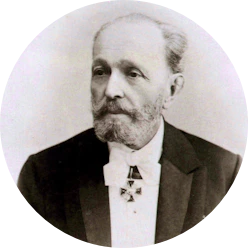
Marius Petipa
March 11, 1818 - Marseille (France) — July 14, 1910 - Hourzouf (Crimée)
About
Born into a family of dancers, Marius Petipa grew to become the “father of classical ballet.” After an itinerant youth he moved to Saint Petersburg in his late twenties; there he remained, starring in and choreographing dozens of ballets under the auspices of the Imperial Theatre. Petipa ushered in the golden age of Russian ballet even as the Empire was in its twilight. Collaborating with some of the greatest composers of the nineteenth century including Pyotr Ilyich Tchaikovsky, he created spectacular productions — both originals such as The Sleeping Beauty and The Nutcracker and revivals including Giselle and Le Corsaire — which have stood the test of time. His productions defined the course of classical ballet in the twentieth century and have formed the core of the standard repertory for more than one hundred years.
The itinerant dancer
Dancing boy
Victor Marius Alphonse Petipa was born in Marseille, France in 1818, in the early years of the Bourbon Restoration. He was the third of six children born to Jean Petipa, a dancer, and Victorine Grasseau-Maurel, an actress and drama teacher. Marius’s older brother, Lucien (b. 1815), was also a dancer (as an adult he was premier danseur at the Paris Opéra). A reluctant pupil, Marius began his studies at the age of seven. When his father won the position of ballet master at the Théâtre de la Monnaie, the family moved to Brussels. There Marius was educated at the Grand College and studied music at the conservatory.
At the age of nine, Petipa began dancing in his father’s traveling company. There he made his debut in a production of Pierre Gardel’s La Dansomanie. Less than a month after France’s 1830 July Revolution, Belgium underwent a revolution of its own. In the wake of this upheaval, Jean Petipa moved his family to Bordeaux where he took a position as ballet master.
The itinerant years
At the age of twenty-one, Marius became premier danseur at the theater in Nantes; there he produced several short ballets. He moved between Nantes and Bordeaux for several years and eventually made his debut at the Comédie-Française in Paris. He continued his studies with dancer Auguste Vestris, who trained many famous dancers of the nineteenth century including the Petipa brothers, Marie Taglioni, and Jules Perrot (who would become Petipa’s colleague two decades later in Saint Petersburg).
In 1843 Petipa returned to Bordeaux, where he was invited to be premier danseur at the Grand Théâtre; there he debuted as Albrecht in Giselle, composed by Adolphe Adam — a role premiered by his brother in Paris two years earlier. The theater soon went bankrupt, so Petipa traveled south to Spain. During his time at the King’s Theatre in Madrid he choreographed numerous works and studied Spanish dance. He toured the country, gathering material he would use in later stagings such as his acclaimed production of Don Quixote. He eventually fell in love with the daughter (or wife; accounts vary) of a Spanish nobleman. When the affair was discovered, Petipa and the nobleman supposedly had a duel. Whether or not the duel actually occurred remains a matter of speculation, but in the wake of the affair Petipa returned to Paris alone.
Saint Petersburg
First years
Petipa departed for Saint Petersburg in May 1847. Though his initial contract with the Imperial Theatre (now the Mariinsky Ballet) was temporary, he remained in the city for the next sixty years. As premier danseur he made his Saint Petersburg debut in a restaging of Joseph Mazilier’s Paquita, with music by Léon Minkus; Tsar Nicholas I was in attendance. Petipa’s first years in Saint Petersburg imparted knowledge he would apply to later masterpieces. From performing the ballets of Jules Perrot and Arthur Saint-Léon he learned the importance of dramatic mimed scenes and the effective juxtaposition of the fantastical into everyday settings; both of these he would use to great effect in his production of Tchaikovsky’s The Nutcracker.
Several years later Petipa became an instructor at the Imperial School. He fell in love with and eventually married one of his students, prima ballerina Mariia Sergeyevna Surovshchikova. He staged numerous productions with her in mind including an 1863 revival of Le corsaire (music by Léo Delibes). Sources disagree on the first original work Petipa staged in St. Petersburg, but all agree that his first great success was The Pharaoh’s Daughter with music by Cesare Pugni.
Chief Choreographer and Premier Maître de Ballet
The Pharaoh’s Daughter was such a triumph that Petipa was appointed chief choreographer of the Imperial Theatre, a position he held for nearly fifty years. He oversaw his productions with meticulous attention to detail, conducting exhaustive research and preparing exquisitely detailed instructions for composers and designers (at least one biographer called his methods “despotic”). While this controlling approach to dramatic unification recalls the Gesamtkunstwerk associated with Richard Wagner, Petipa insisted that choreography take precedence.
Petipa and Minkus premiered Don Quixote in 1869, marking the beginning of a long and successful collaboration. Two years later, they expanded the ballet into an even more elaborate restaging. For his work on Don Quixote Petipa was named premier maître de ballet. With this appointment Petipa ushered in what has come to be known as the golden age of Russian classical ballet. Later in the decade Petipa and Minkus created La Bayadère, one of their most enduring works. Its grand pas classique, “the Kingdom of the Shades,” has become one of the most famous and celebrated scenes in all ballet.
The composers
For the first four decades of Petipa’s tenure, the Imperial Theatre retained a chief composer for its ballets. Italian composer Cesare Pugni held this role until his death in 1870. Minkus, his successor, remained in the role until his retirement some fifteen years later. In 1886, director of the Imperial Theatre Ivan Vsevolozhsky abolished the position of chief composer to encourage musical diversity. This paved the way for Petipa’s partnership with the man who would become Russia’s most famous composer, Pyotr Ilyich Tchaikovsky.
Petipa's final years
The last triumphs
Petipa and Tchaikovsky’s first project, The Sleeping Beauty, premiered in 1890 to immediate success. Soon after, they began work on their second and final collaboration, The Nutcracker, which premiered in 1892 as a double bill alongside Tchaikovsky’s opera Iolanta. In the wake of Tchaikovsky’s death the following year, the Imperial Theatre mounted a revival of his first ballet, Swan Lake; Petipa’s revival has since become famous in its own right. Within just five years, Petipa left his indelible mark on all three of the great composer’s ballets.
To celebrate Petipa’s fiftieth year in Saint Petersburg, the theater staged a lavish series of productions in 1896. As he entered his sixth decade with the company, Petipa primarily staged revivals including The Pharaoh's Daughter, La Esmeralda, and Giselle. Still, even in his eighties he created celebrated new productions, most notably Les Millions d’Arlequin and Raymonda, the latter with music by Alexander Glazunov.
Sabotage
Not everyone was happy with Petipa’s iron grip on the Imperial Ballet. A new director of the Imperial Theatre, Vladimir Telyakovsky, was appointed to the position in 1901. He believed ballet at the company had stagnated and that the old-fashioned Petipa was to blame. Eager for new blood, he did everything he could to push the aging and ailing master out. He blocked Petipa from attending rehearsals, formed a committee to limit Petipa’s powers, and even hired a new choreographer without consulting anyone. When Petipa’s final ballet was set to be premiered in 1904, a month shy of his eighty-sixth birthday, Telyakovsky abruptly canceled the production.
Exile
Despite Telyakovsky’s efforts, Petipa remained popular. Tsar Nicholas II named him “ballet master for life” and granted him a generous pension. Still, Petipa eventually accepted defeat, going into retirement in 1907. He spent his final years living in the Crimean Peninsula in modern-day Ukraine, where he died in 1910 at the age of ninety-two.
Petipa’s work: the cornerstone of classical ballet
The “father of classical ballet,” Marius Petipa choreographed dozens of ballets, divertissements, and opera intermezzos during his sixty-year tenure in Saint Petersburg. He mounted original productions and revivals alike, each with his signature focus on blending dance, music, costumes, and scenery into a transcendent whole. Many of these creations were grand, lavish spectacles, enthusiastically received by his contemporaries and present-day audiences.
Original ballets
Petipa’s first major success in Saint Petersburg was his 1862 production of The Pharaoh’s Daughter. This early triumph typified many of his works: supernatural elements, a martyred heroine, and the inclusion of divertissements that amplified the performance into a grand, multi-act spectacle. Don Quixote, his first collaboration with Minkus, capitalized on nineteenth-century fascinations with exotic Spanish culture. In this massive five-act ballet, Petipa incorporated dances learned from his time touring the Iberian Peninsula as a young man.
His two collaborations with Tchaikovsky, The Sleeping Beauty and The Nutcracker, remain some of the most performed ballets in the canon. Both of these fantastical tales have become favorites for children: Walt Disney adapted the former for his 1959 animated musical film Sleeping Beauty, and The Nutcracker has cemented itself as a perennial Christmas classic. Georgian-American George Balanchine, one of Petipa’s successors, choreographed a production of The Nutcracker that has been performed in New York City almost every year since 1954.
Revivals
Petipa remounted numerous ballets throughout his career. Some of these were adaptations of pieces by other choreographers, while others were based on his own premieres. Many of these, such as his revival of Giselle, have outstripped the popularity of their originals. Giselle was an immediate success when it premiered in 1841 (starring Petipa’s brother Lucien as Albrecht), and it came to Saint Petersburg the following year. During his tenure at the Imperial Theatre, Petipa revived it twice.
Le Corsaire remained an audience favorite. Over a twenty-six-year period, Petipa presented four increasingly lavish revivals of this swashbuckling pirate tale. Following Tchaikovsky’s untimely death, Petipa produced a revival of his first ballet, Swan Lake. This revival has since become one of Petipa’s most performed.
Petipa’s influence on ballet
During his decades-long tenure at the Imperial Theatre, Petipa codified the artistic tenets of classical ballet. Even those successors with decidedly modern aesthetics, such as Michel Fokine and George Balanchine, were indebted to the foundation established by Petipa. Both Fokine (who danced under Petipa) and Balanchine were born and trained in Saint Petersburg and later choreographed for the Paris-based Ballets Russes.
Upon his retirement, Marius Petipa wrote in his memoirs, “I can state that I created a ballet company of which everyone said: Saint Petersburg has the greatest ballet in all Europe.” To this day, the Mariinsky Ballet remains one of the top companies in the world. Yet Petipa’s influence extends far beyond the walls of the Mariinsky. His productions, from the fantastical tale of The Nutcracker to the passionate love story of Giselle, remain some of the most performed ballets the world over.
Marius Petipa: timeline of key dates
- 1818: Marius Petipa is born in Marseille, France.
- 1826: Austrian composer Léon Minkus is born.
- 1830: The Belgian Revolution begins.
- 1840: Pyotr Ilyich Tchaikovsky is born.
- 1847: Petipa accepts the position of premier danseur to the Imperial Theatre of St. Petersburg. His version of Paquita premieres; it is Petipa’s first staged work in Russia.
- 1848: Revolutions spread across Europe, but these collective Revolutions of 1848 are quashed within two years. Karl Marx publishes the first edition of The Communist Manifesto.
- 1853: The Ottomans declare war on Russia, igniting the Crimean War.
- 1854: Petipa marries the prima ballerina Mariia Sergeyevna Surovshchikova. Many of his works are created with her in mind.
- 1855: Petipa’s father, renowned ballet master and pedagogue Jean-Antoine-Nicolas Petipa, dies in Saint Petersburg.
- 1856: Adolphe Adam, composer of the ballets Giselle and Le corsaire and the Christmas carol “Minuit, chrétiens!,” dies. Eunice Newton Foote becomes the first scientist to make the connection between climate change and the amount of carbon dioxide in the atmosphere.
- 1859: Charles Darwin publishes The Origin of Species, putting forward the theory of evolution by natural selection.
- 1862: The highly successful premiere of The Pharaoh's Daughter earns Petipa the title of second maître de ballet to the Imperial Theatre.
- 1869: Don Quixote, Petipa’s first collaboration with composer Léon Minkus, premieres.
- 1870: Composer Cesare Pugni, one of Petipa’s close collaborators, dies.
- 1871: Petipa is named premier maître de ballet.
- 1872: Russian critic and impresario Serge Diaghilev, founder of the Ballets Russes, is born.
- 1877: La Bayadère premieres in Saint Petersburg.
- 1879: Eugene Onegin, Tchaikovsky’s most well-known opera, premieres in Moscow. American inventor Thomas Edison invents the first version of the electric light bulb. Book One of Fyodor Dostoevsky’s final novel, The Brothers Karamazov, is published.
- 1881: Alexander II, Emperor of Russia, is assassinated in Saint Petersburg.
- 1883: Richard Wagner dies.
- 1889: Le Talisman premieres. Russian dancer and choreographer Vaslav Nijinsky is born in Kyiv; one of his first major roles is in a 1910 revival of Le Talisman. The 1889–1890 viral pandemic, one of the deadliest in recorded history, claims nearly 1 million lives.
- 1890: Sleeping Beauty, with music by Tchaikovsky, premieres in Saint Petersburg.
- 1892: The Nutcracker, Tchaikovsky’s final ballet, premieres in Saint Petersburg. Petipa devised the libretto while Lev Ivanov assisted with choreography.
- 1893: Tchaikovsky dies nine days after the premiere of his Symphony No. 6 in B Minor.
- 1898: Lucien Petipa, older brother to Marius, dies in Versailles.
- 1903: The Magic Mirror premieres in Saint Petersburg; the ballet is the last new ballet Petipa completes. Petipa retires from the Imperial Theatre shortly thereafter.
- 1904: Georgian-American choreographer George Balanchine is born in Saint Petersburg.
- 1909: The famed ballet company Ballets Russes debuts in Paris.
- 1910: Petipa dies in Gurzuf in modern-day Crimea.