


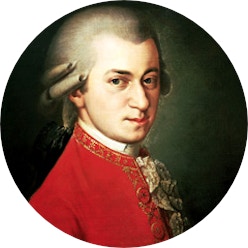
Wolfgang Amadeus Mozart
January 27, 1756 - Salzburg (Austria) — December 5, 1791 - Vienna (Austria)
About
If Beethoven embodies the archetype of the surly, unkempt genius, then Mozart is the playful child prodigy. Despite an early death that continues to inspire intrigue, his catalogue includes well over 600 compositions. Mozart wrote in nearly every major genre of his time—opera, symphony, string quartet, and concerto, to name a few—and set enduring standards of beauty and craftsmanship in all of them. Alongside Haydn and Beethoven, Mozart completes the Viennese Trinity as a consummate composer of the Classical era.
The wandering prodigy
First lessons, first performances
Wolfgang Amadeus Mozart was born in Salzburg, Austria, in January 1756. He was the seventh and final child born to Leopold Mozart, a composer and court musician in Salzburg who wrote a notable textbook on violin instruction. Only Wolfgang and his older sister Maria Anna (nicknamed “Nannerl”) survived infancy. Leopold educated the two children in music as well as other subjects, and it was here that young Wolfgang showed his first signs of genius. At the age of four he began learning the keyboard music his father assigned to Nannerl; he wrote his first pieces a year later.
Soon after, Leopold took the children on a short tour to Vienna. There they played before Empress Maria Theresa and met the young Marie Antoinette. The tour was a success, though the empress was unimpressed. In later years she wrote dismissively of the Mozarts, referring to them as “wandering beggars.” Upon their return to Salzburg, Leopold was promoted to vice-Kapellmeister of the court; here too did the children perform before royalty.
Touring virtuosos
In the spring of 1763 the entire family, both parents and the two children, embarked upon their first international tour. This three-and-a-half-year journey was the first of five tours Wolfgang undertook before he turned eighteen. Traveling through Germany, the Low Countries, and France (where the children played before Louis XV), they eventually arrived in England. The family remained there for more than a year, performing for anyone who would hear them; their audiences included passersby on the street as well as King George III. Here Wolfgang composed his first symphony. He heard the music of Carl Philipp Emanuel Bach, among others. In London he met several composers including Johann Christian Bach, the youngest son of Johann Sebastian Bach. Bach became a family friend as well as a lifelong influence on Mozart. Touring Europe also instilled in the boy a desire to be more than a big fish in the small pond of Salzburg.
In addition to their appearances at court, the children performed before ordinary citizens at home and in small venues. These events were often less formal concerts and more sideshow displays of virtuosity open to any paying customer. Viewers were encouraged to “test” the young boy in a variety of ways, challenging him to sight-read new music, improvise a composition in a particular style, or play with a handkerchief covering the keyboard. The marketing descriptions Leopold printed to advertise these performances grew increasingly hyperbolic; one poster proclaimed the eight-year-old boy “Master Mozart of seven Years of Age … the greatest Prodigy that Europe or Human Nature has to boast of. Every Body will be astonished to hear a child of such tender Age playing the Harpsichord in such a Perfection—it surmounts all Fantastic and Imagination [sic] ….”
Salzburg and Vienna
The family—Wolfgang now ten, Nannerl fifteen—returned to Salzburg in November 1766. The boy continued to compose while his father looked afield in search of opportunities for the wunderkind. In 1768 Leopold attempted to secure a commission for his twelve-year-old son to compose an opera for Vienna, though he was thwarted by rival composers and a scheming impresario. Undeterred, Mozart premiered the opera, La finta semplice, at the Salzburg court in May 1869. Amazingly, La finta semplice was not Wolfgang’s first opera; that honor goes to Apollo et Hyacinthus, written when he was 11.
Despite the sabotage, Mozart’s reputation as a composer and performer continued to grow. By the age of 13, he had composed more than 50 pieces ranging from keyboard minuets and violin sonatas to symphonies and masses, and he was already recognized as a formidable keyboard player.
On the road again
Within the year, Leopold and Wolfgang again departed. In December 1869 the pair set out for Italy. Mozart had been commissioned to write the carnival season’s inaugural opera, Mitridate, re di Ponto. Nannerl, now too old to be exhibited as a child prodigy, remained in Salzburg.
Down and up the Italian peninsula the teenager composed and concertized. The tour was a tremendous success, one reported in the international press. An enthusiastic review from Hamburg reads, “Young Mozart, a famous keyboard player, 15 years old, excited the attention and admiration of all music lovers when he gave a public performance in Venice recently. An experienced musician gave him a fugue theme, which he worked out for more than an hour with such science, dexterity, harmony and proper attention to rhythm that even the greatest connoisseurs were astounded.”
Leopold and his son undertook three Italian journeys in total, returning at last to Salzburg in 1773. Mozart, now 17, had already spent nearly a decade of his childhood as a touring artist.
Final years in Salzburg
By the end of the Italian tours, the Salzburg court had fallen under the leadership of Archbishop Hieronymus Colloredo. Colloredo’s reforms diminished the musical life of Salzburg: among these changes were a reduction in the number of instrumentalists and a marked preference for Italian musicians over locals. Mozart, undaunted, composed additional masses, a keyboard concerto, more than a dozen symphonies, and six string quartets.
As his relationship with Colloredo deteriorated, Mozart turned increasingly toward instrumental and secular vocal music. He completed most if not all five of his violin concertos in these years, as well as some early keyboard concertos. The Piano Concerto No. 9 in E-flat Major, “Jenamy,” represented a new level of musical maturity. In 1777, Mozart asked the Archbishop to release him from his service; Colloredo responded by firing both Mozart and his father.
Soon after, Mozart set out for Mannheim and Paris searching for work. Tragedy struck when his mother, who had been traveling with him, died of a sudden illness. Dejected, unemployed, and now in mourning, Mozart returned to Salzburg, where he was rehired as Colloredo’s court organist. Mozart’s poor relationship with Colloredo came to a head in the spring of 1881: the Archbishop again fired him, this time with, in the composer’s words, “a swift kick on my ass.”
The Vienna years
The musical capital of Europe
Mozart’s mid-20s were a time of joy and frustration both professional and personal. He successfully premiered two operas, the serious Idomeneo, re di Creta and the comic The Abduction from the Seraglio, yet received little of the profits; these were the first of his operas to find a home in the core repertoire. One of Mozart’s early obituaries referred to Seraglio as "the pedestal upon which his fame was erected.” While he won increasing recognition through teaching, composing, and public performances (including a keyboard duel with Muzio Clementi held before Emperor Joseph II), financial mismanagement kept him in debt.
Fired yet again, Mozart briefly moved in with close family friends, the Webers, in Vienna, Europe’s musical epicenter. Under their roof he began courting their daughter Constanze, causing a small scandal. The pair hastily wed in August 1782, scarcely two weeks after Seraglio premiered. A begrudging letter of consent from Leopold arrived the next day.
Growing success
The ensuing years were some of the busiest and most successful of Mozart’s life. He completed his Symphony No. 35 in D Major, K. 385, “Haffner,” not long after his wedding. He gave public and private performances; composed in a variety of forms, publishing symphonies and chamber music alike; and became a Freemason and a father. In early 1784 he composed the first of his twelve major Vienna piano concertos, some of the most important works in the entire keyboard concerto genre.
The year 1785 proved especially auspicious. That fall, Mozart began composing the comic opera Le nozze di Figaro. This would be his first of three legendary collaborations with librettist Lorenzo da Ponte; together, they crafted some of the most widely-performed operas of all time. The premiere of Figaro was a success, with one newspaper reviewer raving, “It contains so many beauties, and such a wealth of ideas, as can be drawn only from the source of innate genius.” The cast received so many calls for encores that the emperor imposed a limit on their number.
On a productive trip to Prague in early 1787, Mozart completed the Symphony No. 38 in D Major, which bears the nickname of the Czech capital. His father Leopold, the most instrumental figure in Mozart’s life, died in the spring. Around that time, a German teenager named Ludwig van Beethoven traveled to Vienna in (unrealized) hopes of studying with Mozart. In October he returned to Prague to oversee his second collaboration with da Ponte, Don Giovanni. It was so successful that Emperor Joseph II offered Mozart a salaried position just to keep him from moving to Prague.
Last years
Final works
Symphonies and vocal works dominate the catalog of Mozart’s final masterpieces. He completed the triptych of Symphonies 39 through 41 in the summer of 1788. In the wake of Don Giovanni’s success he wrote three more operas. The first of these, Così fan tutte, premiered in early 1790; it marked his final collaboration with da Ponte. When Emperor Joseph II died a month later, Mozart was commissioned to write an opera to celebrate the coronation of his successor, Leopold II; La clemenza di Tito premiered in early September 1791. His final opera, Die Zauberflöte, opened later that month.
As work on the operas progressed, Mozart was secretly commissioned to compose a Requiem mass for the wife of a count. Before year’s end, however, Mozart lay dead at the age of 35, the Requiem incomplete.
Finances and health
Mozart’s final years were marked by constant financial woes. He gave fewer public concerts in these years and was paid little for his published works. Though he taught a number of students (most important among these were Johann Nepomuk Hummel and the English composer Thomas Attwood), overspending and mismanagement forced him to borrow money from friends and to move to a cheap suburb of Vienna. A 1789 concert tour of Germany was not enough to ameliorate his financial woes. When he died in December 1791, he was buried in a plain coffin in a common grave (a common misconception is that Mozart was buried in a mass “pauper’s grave”). The cause of his sudden illness and death remains a source of mystery and speculation. Most famous among these is the wild claim that a jealous fellow composer, Antonio Salieri, drove him to his death.
Mozart’s works
Mozart composed in nearly every major genre of his era—opera, symphony, string quartet, and concerto, to name a few—many of which remain among the most popular compositions of all time. Beginning at the age of 5, he completed more than 600 compositions in a span of 30 years. His music, especially those works composed in his final decade in Vienna, epitomize the Classical ideals of balance, beauty, and harmony.
The symphonies
Beginning with a fledgling attempt at the age of 8, Mozart completed at least 41 symphonies. This genre spans nearly the entirety of Mozart’s 30-year compositional career, encompassing all of his stylistic periods from his exuberant youth to the pathos of his last years. Perhaps the first great symphony Mozart produced was his Symphony No. 25 in G minor, written when the composer was 17. Influenced by the dramatic Sturm und Drang movement, its pulsating syncopation and darting strings play over the opening credits of the Mozart biopic Amadeus.
Chief among Mozart’s symphonies are those completed in his final decade while living in Vienna. The Symphony No. 35 in D Major, K. 385—nicknamed “Haffner” after its commissioner—and the Symphony No. 38 in D Major transcend Mozart’s previous symphonic works. He reached even greater heights with his final triptych of symphonies, Nos. 39, 40, and 41. Of this trio, the great German symphonist Johannes Brahms supposedly claimed, “I am able to understand too that Beethoven's first symphony did impress people colossally. But the last three symphonies by Mozart are much more important.”
Mozart completed this trio in a flurry of activity in the summer of 1788. Though all three of these works remain in the core orchestral repertoire, the last two are held in greatest esteem. Romantic composer Robert Schumann described the Symphony No. 4 in G Minor as “a work in which every note is pure gold, every part a treasure!” while music scholar Charles Rosen interpreted the symphony as “a work of passion, violence, and pain.”
Mozart’s final symphony, the majestic Symphony No. 41 in C Major, has more than earned its nickname: “Jupiter.” His longest and most complex symphony, it blends Classical and Baroque forms, culminating in a brilliant fugue. “Jupiter” remains among the most highly regarded and frequently performed symphonies of all time.
Chamber music
Though Mozart wrote dozens of chamber works for a variety of configurations, the string quartets and violin sonatas remain his most celebrated contribution to the genre.
String quartets
Even in his own lifetime, Mozart’s 23 string quartets quickly became canonic. Of these, the six “Haydn” quartets are among the most brilliant string quartets of the Classical era, rivaled only by those written by Haydn himself. Mozart completed the set in 1785 and dedicated them to his friend and mentor, “father of the string quartet” Joseph Haydn. Haydn’s response was enthusiastic: “Before God, and as an honest man,” he raved to Leopold Mozart, “I tell you that your son is the greatest composer known to me either in person or by name. He has taste, and, what is more, the most profound knowledge of composition.”
The “Haydn” quartets were an immediate success, lauded for their melodic brilliance and complex ideas. Mozart composed the pieces in a variety of styles and moods ranging from lighthearted to serious. Yet some were baffled by Mozart’s innovative writing, especially in the so-called “Dissonance” quartet. Some confused publishers even took the liberty of “correcting” Mozart’s “barbarous” mistakes!
Violin sonatas
Including childhood works, Mozart composed nearly three dozen violin sonatas. The sonatas range from “beginner” works written for amateurs to pieces commissioned for some of the greatest performers of his generation. One of the latter, the Sonata for Violin and Piano No. 32, was composed for an Italian virtuoso making an appearance at the Viennese court. Mozart, who played keyboard at the premiere, had not had time to copy his own part onto paper. To fool the audience, he placed a folder of blank pages at the keyboard and played the part from memory.
The concertos
So pivotal is Mozart to the development of the instrumental concerto that the New Grove Dictionary of Music and Musicians gives him his own subsection on the form. Building upon the example of Baroque predecessors such as J. S. Bach, Arcangelo Corelli, and Antonio Vivaldi, Mozart developed and elevated the concerto—particularly the keyboard concerto—into a form on par with the string quartet and symphony. He codified a formal design and interplay between soloist and orchestra that influenced generations of future composers.
Mozart composed more than two dozen keyboard concertos. Those written during his Vienna period are among the most renowned. His Piano Concerto No. 20 in D Minor, a concert stalwart since its 1785 premiere, was a favorite of Romantic-era composers including Beethoven, Brahms, and Clara Schumann; the first-movement cadenza Beethoven composed remains popular. The Piano Concerto No. 23 in A Major, which premiered one year later, has been called “the most beloved of all Mozart’s piano works,” particularly for its operatic, sorrowful second movement. His final piano concerto, the sublime Piano Concerto No. 24 in C Minor, has been ranked among the greatest, if not the greatest, of all Mozart’s concertos.
Mozart also completed five violin concertos, all written during his teenage years living in Salzburg and traveling across Europe. Trained on the violin by his father, Wolfgang’s aptitude for the instrument is on full display in the concertos’ brilliant and virtuosic violin writing. The concertos remain popular bravura showpieces for some of the greatest violinists.
Though less popular than the piano and violin concertos, Mozart’s concertos for other instruments are beloved among musicians. He completed four horn concertos as well as various woodwind concertos; these, particularly the concertos for flute, oboe, and clarinet, remain widely performed.
The operas
Mozart’s influence upon instrumental forms has been profound, yet even that remains overshadowed by the enormous popularity of his operas. Of the nearly 20 that he completed, three of them (Die Zauberflöte, Le nozze di Figaro, and Don Giovanni) are in the top ten most performed of all time; Mozart himself is the most performed composer of opera. From the comic to the dramatic, these works remain mainstays of the repertoire.
Of Mozart’s many operatic works, his three collaborations with Italian librettist Lorenzo da Ponte rank among his most musically rich and dramatically satisfying. Le nozze di Figaro and Così fan tutte set new standards for comic opera, while Richard Wagner, the Romantic composer most known for his massive Ring cycle, called the tragic Don Giovanni “the opera of all operas.” Mozart’s final opera, Die Zauberflöte, abounds with fairy-tale magic and dazzling vocal fireworks from the sinister Queen of the Night. The role of the Queen, with its two fiendishly difficult coloratura arias, sits at the pinnacle of the soprano repertoire.
Mozart’s influence on classical music
The death of Mozart at the age of 35 left the musical world reeling. His music, already popular, became even more so in the wake of his death (helped by the tireless promotional efforts of his widow, Constanze). The hunt for a successor began swiftly. A year after Mozart’s death, Beethoven journeyed to Vienna to study composition with Haydn. One of his patrons, Count von Waldstein, wrote to him, “The Genius of Mozart is still mourning and weeping over the death of her pupil. … With the help of assiduous labour you shall receive Mozart’s spirit from Haydn’s hands.”
Today, Mozart ranks among the most widely beloved and performed composers in all of Western classical music. He has become a pop culture icon synonymous with unfettered genius. Mozart’s life has inspired numerous retellings including Peter Shaffer’s Tony Award-winning play Amadeus; its 1984 film adaptation of the same name won 8 Academy Awards and introduced Mozart’s greatest hits to a new generation of moviegoers.
Mozart’s infectious melodies are instantly recognizable, from the snappy dotted rhythms of “Non più andrai” to the playful lilt of his “Rondo alla turca.” Whether a light-hearted piano sonata or the profoundly sorrowful Requiem, Mozart’s extensive catalog contains brilliantly captivating works that continue to echo in concert halls around the world.
Wolfgang Amadeus Mozart: timeline of key dates
- 1756: Wolfgang Amadeus Mozart is born in Salzburg, Austria.
- 1759: George Frideric Handel dies.
- 1763: Leopold Mozart and his wife embark upon a three-year tour of Europe with Wolfgang and their daughter Maria Anna (Nannerl).
- 1764: Mozart composes his first symphony in London while on tour with his family.
- 1770: Ludwig van Beethoven, a future student of Joseph Haydn’s, is born in Bonn, Germany.
- 1773: Mozart begins his tenure as court musician to Prince-Archbishop Hieronymus Colloredo. He completes the Piano Concerto No. 5 in D major, his first original work in this genre, as well as his Symphony No. 25 in G Minor.
- 1775: The American Revolutionary War begins.
- 1778: Mozart travels to Paris seeking an appointment. During the visit, his mother dies.
- 1781: Mozart resigns his position in the Salzburg court and moves to Vienna as a freelance musician. Emperor Joseph II commissions Mozart to compose an opera in German; The Abduction from the Seraglio premieres the following year.
- 1782: Mozart and Constanze Weber wed. Johann Christian Bach dies.
- 1783: Premiere of the Symphony No. 35 in D Major, nicknamed Haffner.
- 1784: Mozart joins the Freemasons. Masonic ideals permeate his final opera, The Magic Flute.
- 1785: Mozart publishes his six “Haydn” string quartets.
- 1786: The Marriage of Figaro, Mozart’s first of three operas with a libretto by Lorenzo da Ponte, premieres.
- 1787: Don Giovanni, the work Richard Wagner called the “opera of operas,” premieres. Mozart’s father Leopold dies.
- 1788: Mozart completes his final three symphonies, Nos. 39 through 41. Symphony No. 41, nicknamed “Jupiter,” consistently ranks among the greatest symphonies of all time. Carl Philipp Emanuel Bach dies.
- 1791: The Magic Flute, Mozart’s final opera, premieres in Vienna. Two months later, Mozart dies and is buried in a pauper’s grave.