


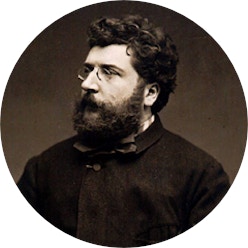
Georges Bizet
25 de octubre de 1838 - París (Francia) — 3 de junio de 1875 - Bougival (Francia)
Acerca de
The thrilling pas de deux of a bullfight. The taut click of castanets. A band of gypsy smugglers. For many music lovers, these images immediately evoke Carmen, the final opera and great triumph of French Romantic composer Georges Bizet. Bizet’s most recognized work, Carmen remains a mainstay of opera houses around the world 150 years after its premiere. Yet he remained largely overlooked in his lifetime, a tragic figure just beginning to realize his potential when he died at the age of 36.
Early years and education
Family background
Bizet was born into a musical family in Paris. Music seemed to come naturally to the young boy; when he wasn’t learning piano from his mother he was eavesdropping on the singing lessons his father gave. His aunt taught solfège at the Paris Conservatoire; his uncle, François Delsarte, devised a system to teach performers, orators, and artists how to express emotions through gesture. Some of his famous students included the actress Sarah Bernhardt, Impressionist painter Edgar Degas, and composers including Richard Wagner, Charles Gounod, and Camille Saint-Saëns.
Education
At the age of nine, he began studying at the Conservatoire. His early teachers included organist François Benoist and Pierre-Joseph-Guillaume Zimmermann, the Conservatoire’s former professor of piano. Bizet was an especially skilled pianist—even impressing the great Franz Liszt—though he chose to pursue composition rather than the life of a touring virtuoso. None of the small pieces he composed for the instrument became part of the core solo piano repertoire. His Jeux d’enfants, a charming set of miniatures for piano four hands, preceded a number of childhood-related French works including Debussy’s Children's Corner and Ravel’s Ma mère l'Oye.
He first studied composition with Fromental Halévy. Halévy’s daughter, Geneviève, later became Bizet’s wife, and his son would co-write the libretti to two of his operas, including Carmen. Perhaps his biggest musical influence was Charles Gounod, composer of the operas Faust and Roméo et Juliette. “You were the beginning of my life as an artist,” Bizet later told his mentor. “I spring from you. You are the cause, I am the consequence.” Through Gounod, he met and befriended Camille Saint-Saëns.
The Prix de Rome and Bizet’s years in Italy
Bizet won the prestigious Prix de Rome on his second attempt (composer Hector Berlioz was on that year’s jury). The prize guaranteed a stipend to live and compose in the Italian capital. At the age of nineteen he arrived at the Villa Medici, where he remained for about three years. The Rome years saw the completion of a handful of works and many more failed attempts. One of these early pieces, an Italian comic opera called Don Procopio, remained unperformed until 1906.
A Misunderstood Genius
Bizet returns to France
Upon receiving word of his mother’s serious illness, Bizet rushed home to Paris. It’s there that he attended the disastrous premiere of Richard Wagner’s Tannhäuser. The opera had a profound effect upon him; he declared Wagner “above and beyond all living composers,” leading to longstanding accusations of “Wagnerism.” Following his mother’s death, he engaged in a brief affair with his father’s housekeeper which produced a son. To keep the tryst secret, they raised the child as Georges’s half-brother.
The years following Bizet’s return to Paris were ones of immense frustration. Operagoers clamoring for revivals of established hits left little room for emerging young talent. He continued to compose small-scale works as part of his Prix de Rome commitment, but he struggled to find inspiring librettos (the discarded subjects include Hamlet, Macbeth, and Don Quixote). His papers reveal numerous aborted efforts and even failed attempts to write his own text. He earned a living primarily by transcribing and arranging the music of others.
Mixed audience reception
In 1863, Bizet received a commission from the Théâtre Lyrique to write a new opera. Les pêcheurs de perles became his first publicly staged work when it premiered later that year. Set in ancient Ceylon (Sri Lanka), the opera tells of two men whose vow of friendship is threatened when they fall in love with the same woman, a priestess torn between their love and her own sacred vow. Though audiences enjoyed the opera, most critics did not, and Les pêcheurs de perles closed after eighteen performances. One of the few critics who took the work seriously was Berlioz. While not a mainstay of the repertory—in large part due to a weak libretto and various muddled, alternate endings—it remains Bizet’s second most performed opera. The Act I friendship duet for baritone and tenor, “Au fond du temple saint,” ([16:36]) has proven especially popular.
His next opera, La jolie fille de Perth, has fared less well. Loosely based upon Walter Scott’s novel of the same name, it attempted to capitalize on the fascination with Scotland that had swept across Europe during the nineteenth century. Bizet’s inventive score displays his Mozartean skill at writing for the human voice. Though one critic hailed the second act as a masterpiece when it opened in 1867, most derided the flimsy love story and absurd libretto. Like Les pêcheurs de perles, La jolie fille de Perth also closed after eighteen performances.
Breakthrough
The ensuing years were marked by frustration and false starts. Bizet was still without a steady income from his own works, leading him to chainsmoke and work long hours at his publishing job; the monthslong Siege of Paris by Prussian armies only added to his stress. His sketches are littered with drafts of unfinished and hardly begun operas. The 1872 premiere of Djamileh, a one-act opéra comique, proved critically unsuccessful, yet Bizet felt that he had at last found his voice.
Bizet’s other work
Symphony in C
Out of Gounod’s mentorship came one of Bizet’s great early works, the Symphony in C, which he wrote shortly after his seventeenth birthday. One of his few original orchestral compositions, the symphony is heavily indebted to Gounod. Perhaps this is why Bizet actively suppressed the piece. He never wrote of it, nor did he attempt to publish it. In fact, it wasn’t until 1935, sixty years after his death, that the symphony was premiered; ironically, it immediately proved popular and remains one of his most performed works. Choreographer George Balanchine used the Symphony for a ballet he originally titled Le Palais de Cristal; when it opened at the Paris Opera Ballet, he changed the name to Symphony in C.
L’Arlésienne
Later that year he completed incidental music for the play L’Arlésienne. Set in Provence, it tells of a tormented young man who commits suicide after learning of the past indiscretions of his fiancée, the titular girl from Arles. To add local color, Bizet included Provençal melodies including the Epiphany carol March of the Kings [9:17]. The play was a failure but, encouraged by his friend and fellow Romantic composer Jules Massenet, he arranged a four-movement orchestral suite from the music. This suite, along with a suite arranged by his friend Ernest Guiraud, remains an audience favorite—especially the concluding Farandole, often performed as a crowd-pleasing encore.
Carmen
A year later, he had completed a first draft of the opera that would become his magnum opus: Carmen. In this tale of love, jealousy, and murder, the titular gypsy seduces and abandons the naive young officer, Don José. He in turn abandons his beloved, Micaëla, joining Carmen and her band of gypsy smugglers. Carmen eventually leaves José for the dashing bullfighter Escamillo, leading to a shocking confrontation between the two former lovers.
Bizet’s score abounds with instantly recognizable earworms. Those who have never set foot inside an opera house will have heard the bold chorus of Escamillo’s “Toréador March” and Carmen’s beguiling “Habanera,” in which she compares love to a rebellious bird. Though tremendously catchy and beautifully orchestrated, the opera’s risqué subject matter nearly kept it off the stage, and it was only after a year and a half of delays that this grand work premiered on March 3, 1875. Paris’s leading musical figures, including Gounod and Massenet, were in attendance. As with Bizet’s earlier works, audiences and critics were polarized. Many were taken aback by the opera’s gritty realism and the amorality of its characters, particularly Carmen. Ironically, it is these very elements that made the opera so influential. Its depictions of death, immorality, and the working class of Seville, while controversial, were groundbreaking, paving the way for greater realism and dramatic expression in opera. The Italian verismo movement—best exemplified by the often-paired operas Cavalleria rusticana and Pagliacci—flowered, in part, due to Carmen’s success.
Carmen’s cool reception left Bizet bitterly disappointed. Three months after Carmen premiered, he died of a heart attack on the night of the show’s thirty-third performance. He was just thirty-six, a year older than Mozart had been when he died. His funeral was attended by over 4,000, including old friends and colleagues from the Conservatoire. Gounod, his mentor, gave a tear-stained eulogy.
Bizet’s Influence
In a cruelly ironic twist of fate, Bizet would never know that Carmen had catapulted him into the musical firmament. It quickly spread to opera houses around Europe. Luminaries like Brahms and Wagner praised the work (Brahms apparently saw it twenty times), and Nietzsche favorably declared it an antidote to “Wagnerian neurosis.” Tchaikovsky, who attended the original production in Paris, heaped numerous accolades upon it. “If any contemporary opera is fated to outlive our century,” he wrote, “then it is precisely this opera.”
Tchaikovsky’s prediction proved accurate: Carmen is the most performed French-language opera in the twenty-first century, and the third-most performed opera in any language. Its orchestra suite continues to appear on symphonic programs; numerous musicians, including pianist Vladimir Horowitz [54:32], have arranged and transcribed the score; and the Broadway musical Carmen Jones and its cinematic adaption showcased some of the twentieth century’s great African American actors. With its memorable melodies and timeless themes of love, lust, and jealousy, Carmen will surely remain an audience favorite for generations to come.
Georges Bizet: timeline of key dates
- 1838: Georges Bizet is born in Paris to a musical family
- 1848: admitted to the Paris Conservatoire at the age of nine; prolific bel canto opera composer Gaetano Donizetti dies
- 1849: wins first prize for solfège and begins taking private lessons with Zimmermann; Frédéric Chopin dies
- 1853: upon Zimmermann’s death, Bizet joins Halévy’s composition class
- 1855: composes the Symphony in C; Ernest Chausson born
- 1857: wins a prize offered by Offenbach for his setting of the one-act opera Le Docteur Miracle; the opera is produced that year; he also wins the Prix de Rome. Mikhail Glinka dies. Edward Elgar born.
- 1858: begins his studies in Rome
- 1859: completes his opera buffa Don Procopio; German composer and friend of Beethoven Louis Spohr dies
- 1860: Isaac Albéniz born; Gustave Charpentier born; Gustav Mahler born
- 1861: Bizet attends the disastrous Paris premiere of Wagner’s Tannhäuser. He declares Wagner “above and beyond all living composers.” Bizet’s mother dies.
- 1862: his father’s housekeeper gives birth to a son fathered by Bizet. To hide the affair, the child is raised believing that Bizet is his half-brother. Claude Debussy born; Frederick Delius born; Fromental Halévy, Bizet’s teacher and father of his future wife Geneviève, dies
- 1863: Les Pêcheurs de perles premieres at the Paris Théâtre Lyrique. It ran for eighteen performances but was not presented again in Bizet’s lifetime.
- 1866: completes the opera La Jolie Fille de Perth; Ferruccio Busoni born; Erik Satie born
- 1868: completes the last version of his Roma Symphony, Souvenirs de Rome. Begun during his studies in Rome, the work never completely satisfied Bizet. Gioachino Rossini, whom Bizet had admired since meeting him as a teenager, dies
- 1869: marries Geneviève Halévy; Hector Berlioz dies
- 1872: the one-act Djamileh premieres at Opéra-Comique. Despite its poor reception, Bizet feels that he has found his way as a composer. Composes incidental music to L’Arlesienne; this too is a failure, but the first orchestra suite becomes an immediate success. Geneviève gives birth to their son, Jacques. Alexander Scriabin born; Ralph Vaughan Williams born
- 1873: Bizet begins composing Carmen. Sergei Rachmaninov born; Max Reger born
- 1874: Rehearsals for Carmen begin. Gustav Holst born; Arnold Schoenberg born; Josef Suk born
- 3 March 1875: premiere of his final opera and magnum opus, Carmen, at the Paris Opéra-Comique; Maurice Ravel born four days after the premiere
- 3 June 1875: Bizet dies of a heart attack in Bougival, a western suburb of Paris, on the night of the thirty-third performance of Carmen