


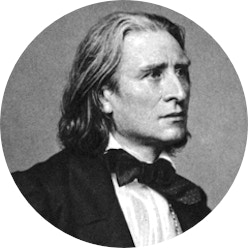
Franz Liszt
22 de octubre de 1811 - Raiding (Hungary) — 31 de julio de 1886 - Bayreuth (Germany)
Acerca de
Pianist, composer, conductor, dandy, intellectual and religious father, Liszt fascinated 19th century Europe. A child prodigy, he was taught by Czerny and Salieri in Vienna. Already famous at the age of fifteen, he revolutionised piano techniques and established the recital for piano solo as he covered the world performing either his opera transcriptions, Years of Pilgrimage or Hungarian Rhapsodies. Before 1830, not only Germany, Switzerland, England and France, but the whole of Europe knew and admired Liszt.
As a composer, he opened up new paths and hoped, in his own words, “to thrust a javelin into the indefinite space of the future”. Modern and revolutionary, the musical adventurer integrated his numerous travels into his writing, whether it be folklore or the findings of his contemporaries. Between digital transcendence and spiritual deprivation, Liszt’s work reflects his generosity.
For ten years beginning in 1848, he was the chapel master in Weimer where he tirelessly promoted contemporary composers like Wagner, Berlioz and Saint-Saëns giving first performances of their works. Having led a passionate and troubled love life, in 1865 he retired to Rome to receive the tonsure from the Franciscan monks. From the effervescence of the stage, via romantic conquests and his many journeys, this wild gypsy became a mystical father. His rhapsodies and paraphrases were transfigured into Grey Clouds or Lugubres Gondola.
After the 1870s, his quest for total lack of ornamentation was characterized by the loss and separation from tonality, running out of thematic material and ascetic austerity. In order to open the doors to the future, Liszt closed all other possibilities. His music became fragmented, Bagatelle without tonality or Via Crucis bear witness to his last musical sigh, which he hoped would draw him closer to new horizons beyond death.