


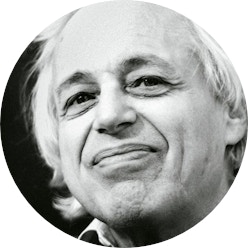
György Ligeti
May 28, 1923 - Târnăveni (Romania) — June 12, 2006 - Vienna (Austria)
About
Childhood and historical context
Born on May 28, 1923, in Transylvania (now Romania), György Sándor Ligeti grew up in a Hungarian Jewish family. His father was an economist and his mother a doctor. Ligeti began studying the piano at a very young age and showed exceptional musical talent very early on.
Ligeti’s childhood and adolescence were marked by major political upheavals in central Europe. The rise of fascism and anti-Jewish legislation all but destroyed his family. In 1944, Ligeti was deported to a forced-labor camp in Hungary, while his father and brother perished in Nazi concentration camps. Only Ligeti and his mother survived the Holocaust.
Education
After the war, Ligeti resumed his musical studies at the Franz Liszt Academy in Budapest, where he studied composition with Sándor Veress and Ferenc Farkas, and ethnomusicology with Zoltán Kodály. These teachers were crucial during his early years, for they instilled in him an appreciation for the richness of Hungarian and Romanian folk music, in turn influencing his future works.
During the 1950s, Ligeti taught harmony, counterpoint, and musical analysis at the Budapest Academy. It was a difficult period for creatives of all sorts: communist Hungary imposed Socialist Realism and censored Western avant-garde music. Ligeti thus composed in secret, for he was fascinated by avant-garde music. He explored new compositional techniques in isolation, without access to the scores of contemporary Western composers such as Arnold Schoenberg or Anton Webern, who also took a liking to contemporary practices.
Escape to the West and artistic renewal
In December 1956, following the failure of the Hungarian uprising and Soviet intervention, Ligeti fled to the West with only a few scores sandwiched in his luggage. He arrived first in Vienna, then traveled to Cologne, the epicenter of European avant-garde music. It was there that he discovered the electronic music studio of the WDR (Westdeutscher Rundfunk) and met the leading figures of new music: Karlheinz Stockhausen, Gottfried Michael Koenig, and Pierre Boulez.
His encounter with Stockhausen and the world of electronic music changed his entire outlook on music and its possibilities. Although Ligeti composed only a few purely electronic works (notably Artikulation in 1958 and Glissandi in 1957), the studio experience radically transformed his approach to composition. He developed a new understanding of sound, one that no longer focused on traditional melody or harmony, but rather on texture and constantly transforming sonic mass.
Ligeti’s works
Micropolyphony and the Ligeti style
Micropolyphony is the technical innovation that best defines Ligeti’s musical style. This term, which he coined himself, refers to a compositional technique in which numerous individual voices are layered extremely densely, creating an overall sonic texture that might be described as a constantly shifting harmonic “cloud.” Think of fuzzy radio sounds as you turn the dial slowly and the sounds shift in pitch, or when clouds shift so subtly across the sky that you don’t notice a change in shape until after they’ve moved. Rather than perceiving distinct melodies, the listener perceives sound masses, slowly evolving clusters that create a global, paradoxical sensation of stillness amidst intense internal, microscopic activity.
This technique finds its most accomplished expression in Atmosphères (1961) for large orchestra. The work begins with a chromatic cluster of 53 notes played simultaneously by the strings, creating a sound texture of unprecedented density. No melody emerges: it is the imperceptible transformations of this sound mass that constitute the musical discourse. Ligeti thus creates music that appears static but is in reality permeated by constant micro-variations.
Ligeti’s music can sometimes seem difficult to listen to due to several factors. First, traditional harmonic and melodic conventions are effectively thrown out the window: there is no clear tonality, no recognizable themes, and no regular rhythmic pulse. Second, the density of the micro-polyphonic writing requires attentive listening to grasp the subtle transformations in timbre and texture (so not good for road trip music). Finally, Ligeti frequently plays with the limits of auditory perception, creating sonic illusions and acoustic effects that may unsettle listeners more used to traditional Western classical music with its clear reference points.
The rejection of rigid norms
Ligeti distinguished himself from composers of his generation by his refusal to adhere to a rigid compositional system, preferring total freedom in his approach. Rather than limiting himself to one specific style, Ligeti found knowledge and inspiration everywhere.
This independent spirit is also evident in his relationship to musical history. While his music is resolutely modern, Ligeti’s influences are historically and culturally diverse; Renaissance motifs, African rhythms, and Central European folk melodies fueled his imagination. In his late works, such as his three books of Études for piano (1985-2001), he incorporates influences as diverse as African polyrhythms, mechanical music, and even the works of Chopin and Debussy, all translated into his unique compositional language.
Ligeti also possessed a sense of musical humor which was rare among the serious avant-garde artists of his time. Works such as Poème symphonique for 100 metronomes (1962) or certain passages from his opera Le Grand Macabre (1974-1977) contain a playful and satirical dimension that stands in stark contrast to the intellectual seriousness of contemporary music.
Ligeti’s essential works
- Atmosphères (1961)
This orchestral work is the quintessence of Ligeti’s micropolyphony. Composed for a large orchestra without percussion, it creates sound textures of unprecedented richness, where 89 musicians play individual parts that merge into complex harmonic masses. The work unfolds without apparent breaks, like a long cosmic breath.
- Lux Aeterna (1966)
Written for a 16-voice mixed a cappella choir, Lux Aeterna applies micropolyphony to the human voice. The Latin text (“Eternal Light”) is fragmented and layered in such a way that the words become indistinct, creating an ethereal vocal luminosity. It is one of Ligeti’s most famous works, even among modern audiences thanks to its inclusion in Stanley Kubrick’s 2001: A Space Odyssey (1980).
- Requiem (1963-1965)
For soprano, mezzo-soprano, two mixed choirs, and orchestra, this monumental work reimagines the Mass for the Dead using a radically modern musical language. Vocal and orchestral clusters create an atmosphere of exceptional dramatic intensity, evoking both dread and transcendence.
- The Cello Concerto (1966)
This work explores the timbral possibilities of the cello in dialogue with the orchestra. Ligeti develops a virtuosic score for the soloist, while maintaining the micro-polyphonic textures that characterize his style.
- Le Grand Macabre (1974-1977, revised in 1996)
Serving as Ligeti’s only opera, this work, based on Michel de Ghelderode, is a grotesque apocalyptic farce where the absurd meets the tragic. Blending historical references, parody, and sonic innovation, this opera demonstrates Ligeti’s ability to combine avant-garde and theatricality.
- Piano Studies (1985-2001)
Three volumes make up 18 studies that push the technical and musical limits of the piano. Each study explores a different concept: complex polyrhythms, acoustic illusions, rhythmic mechanisms, and so on. Ligeti’s studies have become essential cornerstones in the contemporary piano repertoire.
- Piano Concerto (1985-1988)
Ligeti’s Piano Concerto, written later in his life, is an epitome of his musical style, characterized by rhythmic complexity, dense polyphony, and references to various musical traditions from Balinese gamelan to African dance rhythms.
Ligeti’s legacy
Influence on contemporary music
György Ligeti exerts a monumental influence on contemporary music. His micropolyphony inspired many composers seeking to push beyond the limits of serialism without sacrificing complexity. Composers such as Tristan Murail and Gérard Grisey owe a great deal to Ligeti, among others.
Beyond art music, Ligeti also influenced the worlds of film music and electronic music. His explorations of sound texture and orchestral mass opened up new possibilities for film scores that composers have widely exploited. Electronic music artists regularly cite Ligeti as a reference, particularly for his ability to create immersive soundscapes.
Stanley Kubrick and Ligeti
Ligeti owes much of his international fame to Stanley Kubrick, who used his music in three of his major films, transforming these avant-garde works into true icons of popular culture.
In 2001: A Space Odyssey (1968), Kubrick uses several of Ligeti’s works: excerpts from Atmosphères accompany the silent space scenes, creating an atmosphere of cosmic unease; the Requiem underscores the appearance of the mysterious black monolith; and Lux Aeterna is heard during the lunar shuttle scene. These musical choices, initially part of a temp track during editing, became final as Kubrick felt that no original music could rival Ligeti’s.
In The Shining (1980), Kubrick again uses Lux Aeterna, as well as the slow movement of the Chamber Concerto to reinforce the atmosphere of dread and madness that pervades the film. Ligeti’s micro-polyphonic textures fit perfectly with the tone of the film, creating a sense of spine-chilling unease.
In Eyes Wide Shut (1999), Kubrick uses the second piece from Musica ricercata for piano, in an orchestrated version by Dominic Harlan. This minimalist, repetitive music accompanies the mysterious masked ceremony scene, adding a ritualistic dimension.
For many, Ligeti’s music magnifies Kubrick’s cosmic vision within his films, although there are those who criticize the use of classical music in film as fundamentally altering the music in the public eye.
György Ligeti, who died in Vienna on June 12, 2006, leaves behind a body of work of exceptional richness and originality. An elusive contemporary composer who refused to be confined to any school or system, Ligeti created an instantly recognizable sonic universe that solidifies his place as a defining figure of 20th-century music.
To listen to Ligeti is to allow oneself to be unsettled, to let go of familiar reference points, and plunge into a sonic richness where sounds become architecture, where silences speak. It is also to discover a sensual beauty and an expressive power that reward the attentive listener.