


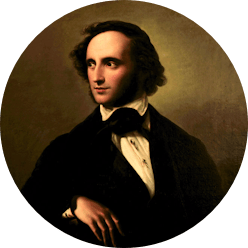
Felix Mendelssohn
3 de febrero de 1809 - Hamburg (Germany) — 4 de noviembre de 1847 - Leipzig (Germany)
© Wilhelm Hensel (1847)
Acerca de
The brilliant Romantic, Mendelssohn, was a descendant of a great Jewish-German family where intellectual values and morality were firmly placed at the center of any preoccupation. His grandfather, Moses, (1729-1786), an eminent figure in German philosophy, his father Abraham, (1776-1835) a very prosperous banker and his wealthy and cultured mother, Lea, provided the ideal conditions for the very talented young composer to blossom.
Mendelssohn was taught by the greatest masters, studied the classics, understood ancient languages, painted and rose at 5 o’clock each morning. Unsurprisingly, he made his first public appearance at the age of nine and at fourteen had already composed several great works. A Midsummer Night’s Dream, which he wrote at the age of seventeen, is an unequalled example.
Mendelssohn was admired throughout Europe for being an outstanding artist. Held in esteem by Goethe, he rediscovered and played Bach’s Saint Mathew’s Passion, conducted music composed by his contemporaries and made his favourite city Leipzig into the music capital of Germany. He founded the Conservatory there and asked Schumann to give the composition classes.
Mendelssohn’s work blossomed within radiant and balanced Classicism and fantastic and impalpable Romanticism. The clarity of his melodic genius was radiant while his forms were always intelligible and solidly structured. Whether he was treating themes of travel (Scottish Symphony, 1842), spirituality, (Reformation Symphony, 1830 or Elijah Oratorio, 1846), or virtuosity, (the violin or piano concertos), Mendelssohn possessed an evident charm, the asset of rapidity and light as a guide. Just as his success came very early, he died in 1847 at the early age of 38 devastated by his sister’s death and succumbing to overwork.