


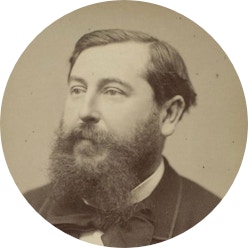
Léo Delibes
February 21, 1836 - La Flèche (France) — January 16, 1891 - Paris (France)
About
Clément Philibert Léo Delibes, known as Léo Delibes, was a 19th century French composer whose ballets and lyric pieces are emblematic of Romanticism and French musical style. He was born on 21 February 1836 in the village of Saint-Germain-du-Val (now part of La Flèche) in the Sarthe region of France. Most of his family were musically minded: his mother (Élisabeth Clémence Batiste) was a gifted amateur musician, his father was a postal worker, his maternal grandfather sang as an operatic countertenor (Jean-Matias Batiste), and his uncle was an organist. The latter, Antoine Édouard Batiste, played an influential role in young Léo’s education after his father died prematurely when Léo was just 11 years old. His uncle taught him musical theory which allowed him to enrol the following year at the Conservatoire de Paris, known at the time as the École Royale de Chant et de Déclamation on rue de Bergère in Paris. He studied composition, under the tutelage of Adolphe Adam, and keyboards (piano, organ, harmonium). In 1850, the conservatoire awarded him the Premier Prix de Solfège. Parallel to his studies, Léo Delibes joined the Maîtrise de la Madeleine, an experience that paved the way for his entry into the Opéra de Paris choir as choirmaster. Three years later, Léo Delibes was appointed organist at Saint-Pierre de Chaillot church, then accompanist at the Théâtre-Lyrique in 1855, at only 20 years of age. It was around this time that he started to write his first compositions and attend performances such as Bizet’s Les Pêcheurs de perles. Around ten years later, he became second chorus master at the Opéra de Paris, while retaining his role as organist. In 1881, he also became professor of composition at the Conservatoire de Paris and, two years later, a member of the Fine Arts Academy. In 1872, Delibes settled in Clichy, just outside Paris, with his young wife Léontine Denain, born Léontine Estelle Mesnage. In 1891, Léo Delibes died in Paris at the age of 55 and was buried at Montmartre cemetery.
Léo Delibes and Romanticism
Throughout his studies, Delibes worked closely with Adolphe Adam, a distinguished French composer and musician who is often associated with the Romantic ballet genre. In 1858, Delibes proposed an extended version of his ballet Le Corsaire (1856) with music by his professor. He also took part in the musical composition of the ballet La Source, in competition with the Austro-Hungarian master Léon Minkus. His first steps into the ballet genre were highly successful, and he became its new figurehead. In 1870, the Opéra rue Le Peletier commissioned him to compose the ballet Coppélia, la fille aux yeux d'émail, better known simply as Coppélia, based on Hoffmann's tale of Doctor Coppélius and his mechanical doll. The work proved a major success with audiences and musicians alike, including Tchaikovsky. Six years later, he enjoyed more success with his ballet Sylvia ou la nymphe de Diane based on a libretto by Jules Barbier and Jacques de Reinach and featuring a chapter from Greek mythology. The work premiered at the Opéra Garnier as the institution's first ballet. With these two works, Delibes boldly challenged the musical genre of ballet, offering a complete musical piece rather than a mere accompaniment to danced variations.
Léo Delibes, master of mélodie
His work as a choirmaster and the likely influence of his tragedienne mother-in-law’s acting work for the Comédie-Française inspired Léo Delibes to take a particular interest in the lyric arts, and more specifically in the genres of mélodie (a type of French art song), opera, and operetta. When he joined the Théâtre-Lyrique theater in Paris, Léo Delibes proposed his initial compositions to a nearby theater, the Théâtre Déjazet, formerly the Folies-Nouvelles. These included Deux sous de charbon, Deux vieilles gardes, and Six demoiselles à marier in 1856, and Les musiciens de l’Orchestre in 1861. These works, some of whose scores have since been lost, laid the foundations for Léo Delibes' continued success in the operetta genre. In 1874, he composed the mélodie Les filles de Cadix, based on an Alfred de Musset poem. The song’s hispanic-inspired style and theatrical aspects make it one of the most famous of the composer’s fifty mélodies. In 1879 and 1882, his music accompanied the lines of Comédie-Française actors in Victor Hugo's plays Ruy Blas and Le Roi s'amuse. He reworked the music of ancient dances to accompany scenes on stage. Léo Delibes finally made his mark in the operatic genre with his most famous work, Lakmé, which he based on Le mariage de Loti, a short story by Pierre Loti. This major work of French Romanticism depicts the daughter of a priest of Brahma and a British officer, entangled in an impossible love story set in 19th-century British India. First composed at the Opéra-Comique theater in 1883, certain themes from the opera are now globally recognised. The young Lakmé is represented by a coloratura soprano—a role that is now standard in the repertory for that soprano tessitura. The aria, Scène et Légende de la Fille du Paria (Scene and Legend of the Outcast Daughter), is both a musical and vocal showpiece that has been performed by such distinguished performers as Mady Mesplé and Natalie Dessay. The Duo des Fleurs (Flower Duet) featuring the young girl and her servant Mallika is a well-known polyphonic song, widely used in popular culture. In addition to its dazzling vocal aspects, the opera is the fruit of more than two years of reflection and research: the composer included in his score melodies, melismas and instrumentation that he had picked up in Turkey, notably in the context of an orientalist movement that favored forms of exoticism. Lakmé is one of the most widely performed operas on contemporary international stages. Following this triumph, Léo Delibes began composing the opera Kassya, for which Jules Massenet wrote the orchestration. This final work remains unfinished.