


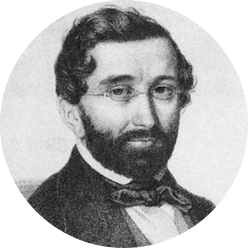
Adolphe Adam
July 24, 1803 - Paris (France) — March 5, 1856 - Paris (France)
About
Adolphe-Charles Adam, from classes with François-Adrien Boieldieu to the Prix de Rome
Born in the heart of Paris in 1803, Adolphe Adam did everything he could to pursue his dream of becoming a musician, despite his family’s reluctance. His father, Jean-Louis Adam, composer and piano teacher at the Conservatoire de Paris, had been the young Adolphe’s first music tutor and yet did not want his son to devote himself to a musical career. Adolphe was not going to give up his passion and kept his musical studies secret from his father. Bored with academic studies, he quit classes along with fellow student Eugène Sue, who later became his librettist. His secret musical training paid off, and at the age of 14, he began studying under composer François-Adrien Boieldieu, famous for his refined, humorous operas that won over Parisian audiences who had grown tired of lyrical tragedy. Throughout his musical studies, Adolphe Adam’s only goal was to become a famous composer. The young Adam made great strides towards this goal in 1825 when he won second prize at the Prix de Rome for his cantata Ariane, behind none other than French composer Albert Guillon. That same year, his former teacher Boieldieu entrusted him with part of the writing for his comic opera La Dame Blanche. Adam also wrote a piano transcription of the opera, which is still considered one of Boieldieu's greatest works. Following in his master's footsteps, Adolphe wrote a number of comic operas himself that often met with brief but resounding success. He also enjoyed writing ballets, such as Giselle, which remains one of the world's most performed Romantic ballets to this day. All in all, Adam composed a total of 44 comic operas and 14 ballets, as well as numerous other works including vaudevilles, sacred music and piano pieces. Alongside his prolific career as a composer, he also took over from his father as piano teacher at the Conservatoire de Paris. The composer also devoted himself to writing articles, an endeavor he initially took up in order to pay off debts incurred by the closure of theaters during the Revolution. He continued to write articles as a pastime until his death in 1856.
Adolphe Adam, prolific comic opera composer
His Prix de Rome win marked a turning point in Adolphe Adam’s career as it sparked his gradual transition from talented student to widely acclaimed composer. In 1826, he decided to broaden his musical horizons by travelling around Wales, Germany, and Switzerland. It was in Geneva that he met French playwright and librettist Eugène Scribe, who entrusted Adam with two librettos. This gave Adolphe-Charles Adam the opportunity to immerse himself in his favorite repertoire, the “opéra-comique,” and he composed his first opera of the genre, Le mal du pays ou La batelière de Brienz, which was performed at the Théâtre du Gymnase on 28 December 1827. One year later, the composer’s next comic opera Pierre et Catherine was rather successful at the Opéra-Comique theater in Paris. The light, colourful nature of his music attracted audiences for 80 shows. His collaboration with the Opéra-Comique theater continued with his works Danilowa, Trois jours en une heure, Les Trois Catherine, Joséphine or Le Retour de Wagram in 1830, followed by Le Grand Prix ou Le Voyage à frais communs, Le Morceau d'ensemble, and finally Casimir in 1831. The French “July” Revolution of 1830 disrupted musical life in Paris and theaters were made to close for a while. This unexpected interruption to his work led Adolphe-Charles Adam to take his career overseas. He left his hometown for London, where his brother-in-law, director of the King's Theatre, lived. There, he composed two comic operas: His First Campaign and The Dark Diamond, performed in 1833 at London's Covent Garden. A year later, he concluded this English interlude and returned to Paris to continue his collaboration with the Opéra-Comique. He continued to work tirelessly, but it was not until 1834 that he enjoyed his greatest success with Le Chalet, a one-act comic opera based on a libretto by Eugène Scribe and Mélesville. Inspired by his cantata Ariane, which won him second prize at the Prix de Rome, Le Chalet was performed regularly at the Opéra-Comique theater for several decades, reaching 1000 performances in 1873. By this time, Adam's career as an opera composer was at its peak, and in 1936 he premiered Le Postillon de Longjumeau, which became an emblematic opera of the genre, both in France and abroad (a certain Wagner conducted this comic opera in Riga!). Le Postillon de Longjumeau also earned him the recognition of his predecessors, notably his master Boieldieu, who wrote: “I would have liked it to be mine.” Adolphe-Charles Adam went on to write several more comic operas before he died. Si j’étais Roi, first performed at the Théâtre Lyrique in 1852, was particularly popular with audiences and was later performed abroad, notably in Turin and Brussels. Adolphe-Charles Adam's many vocal compositions were not limited to opera. His Cantique de Noël, later renamed Minuit, Chrétiens, can still be heard as the opening hymn at Midnight Mass.
Adolphe Adam, master of the Romantic Ballet
In addition to his string of operas, Adolphe-Charles Adam's 14 highly modern ballets represent an undeniable stylistic turning point for the composer. While other ballet music of the time simply accompanied on-stage action, Adam’s was an essential element of the drama and used leitmotivs, recurring melodic fragments that add unity and a powerful sense of narrative to the music. La Fille du Danube, the third ballet after La Chatte Blanche (1830) and Faust (1833), was premiered at the Paris Opéra in 1836 and met with considerable success in France and abroad. As the French language was fashionable in Russia, the ballet was performed a year later at the Bolshoi Theatre. Then, in 1841, Adam’s innovative new ballet Giselle brought a new dimension to the world of ballet music with the appearance of leitmotivs. The work became a benchmark of Romantic ballet, so much so that Tchaikovsky would re-read Giselle before starting to write a new ballet. He wrote of Giselle: “It is a poetic, musical and choreographic gem”. The composer's last ballet, Le Corsaire, was premiered at the Opéra de Paris in 1856, just a few days before his death, and earned him the admiration of his peers. Inspired by a poem by Byron, Le Corsaire captivates with its dramatic intensity. Joseph Mazilier's original choreography remains legendary, not least for its famous, particularly virtuosic pas de deux.