


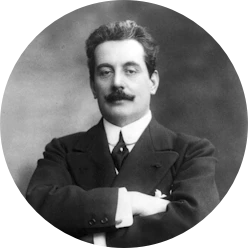
Giacomo Puccini
December 22, 1858 - Lucca (Italy) — November 29, 1924 - Bruxelles (Belgium)
About
Giacomo Puccini was a late 19th- and early 20th-century Italian composer chiefly known for his contributions to opera, a field in which he remains one of history’s most celebrated figures. Known for their lyricism, expressiveness, and dramatic Romantic heights, nearly all of Puccini’s operas continue to find favor with today’s audiences, especially La Bohème, Tosca, Madama Butterfly, and Turandot. Born into a family of musicians in Lucca, Puccini trained in Milan before beginning to compose his first operas to increasing success. He led a tumultuous life full of passion, doubt, and scandal up to his untimely death, leaving behind his unfinished final opera, Turandot.
Youth and education
Birth and family background
Giacomo Puccini was born on December 22, 1858, in Lucca, Tuscany, into a family of musicians and avid music lovers. His father, Michele Puccini, was a musician and composer who held the prestigious position of choirmaster and organist at Lucca Cathedral, a role passed down from father to son for several generations within the Puccini family. Michele died when Giacomo was only five, and he was primarily raised by his mother, Albina Magi. Recognizing her son’s talent early on, Albina played an essential role in Giacomo’s musical education and encouraged him to fulfill his great potential.
First steps in music
After his father’s death, Giacomo Puccini began his musical training in Lucca. He studied organ and choral singing with well-known musicians in his region and quickly became an organist, following the family tradition. He focused primarily on sacred music in his early training, composing his first works in this style that offered an early glimpse into his creative genius.
In 1876, Puccini and his brothers walked nearly twenty miles to attend a performance of Verdi’s Aida at the Teatro Verdi in Pisa. This encounter with Verdi’s monumental work would prove transformative, turning Puccini definitively away from religious music and toward opera. Profoundly moved by the form’s unique alchemy of music, voice, and theatre — and its ability to touch audiences so directly with its intense expressions of passion, conflict, and romance — Puccini knew that he wanted to create this kind of art as well. He devoted himself to composing operas, a calling from which he would never deviate.
Studies in Milan and first opera: Le Villi
In 1880, Giacomo Puccini left Lucca for Milan to join the ranks of the renowned Giuseppe Verdi Conservatory. He studied composition under greats such as Amilcare Ponchielli (known today for La Gioconda and its famous “Dance of the Hours”), who played a decisive role in steering him towards opera. Taking advantage of the city, Puccini immersed himself in Milan’s vibrant artistic scene and the major musical trends of his time.
It was in Milan where he composed his first opera, Le Villi, in 1884. Though it did not win the competition for which it was created, it eventually premiered to great success thanks to Ponchielli’s support. Inspired by a fantastical legend from Central Europe, Le Villi already showed the hallmarks of the young composer’s art: a keen sense of drama, melodic richness, and an almost limitless capacity for expression. This opera caught the eye of music publisher Ricordi, marking the true beginning of Puccini’s career as an opera composer.
Puccini’s golden age
First success: Manon Lescaut
Premiered in 1893, Manon Lescaut was the first opera to bring Giacomo Puccini international recognition. Inspired by Abbé Prévost’s novel, this opera tells the story of the passionate and tragic love between Manon and Des Grieux, shaken by desire, ambition, and cruel twists of fate. Puccini’s intensely lyrical music foregrounds the work’s striking emotionality, ever a hallmark of his personal style.
The composition of Manon Lescaut began under challenging circumstances: the subject had already been successfully tackled by Massenet in Manon, and many doubted Puccini was up to the colossal task. The opera, however, proved to be an instant triumph that propelled Puccini into the limelight. He became a major figure in Italian opera, a place of honor further solidified by his later masterpieces La Bohème and Tosca.
La Bohème
La Bohème depicts the daily lives of young, struggling artists in Paris and their longing for love, friendship, and freedom, epitomized in the relationship between Mimì and Rodolfo. Premiered in 1896 at the Teatro Regio in Turin, this opera is inspired by Henri Murger’s collection of short stories, Scènes de la vie de bohème. Puccini’s elegant style here relies on memorable melodies and dramatic sensitivity rather than over-the-top theatricality.
Composed amid a rivalry with the composer Ruggero Leoncavallo, who was working on the same subject, La Bohème initially received a mixed response from the public. However, its powerful musical composition, the sincerity of its drama, and the vividness with which Puccini portrays the characters’ daily lives and emotions gradually won over audiences. The opera soon became a massive international success and once again showed off Puccini’s rare gift for grand drama grounded in identifiable human emotion.
Tosca
Tosca is an intense dramatic cauldron spilling over with romantic passion, politics, and betrayal. The opera tells the story of opera singer Floria Tosca and her lover Mario Cavaradossi, who face the cruelty of Baron Scarpia in Napoleonic Rome. Puccini’s dramatic style reaches its peak in Tosca, with every aria and nearly every bar of music serving to heighten the psychological tension.
Puccini sought to explore dark and realistic plots with this opera, a far cry from the light romanticism of his previous operas. From its premiere, Tosca was a huge success, largely thanks to the power of its characters. The world-famous aria “E lucevan le stelle,” sung by Cavaradossi, remains one of the most recognizable tenor arias of all time, and Tosca’s aria “Vissi d’arte” became a favorite of great sopranos like Maria Callas.
Madama Butterfly
Madama Butterfly tells the heartbreaking story of Cio-Cio-San, a young Japanese woman married to American officer Pinkerton, who cruelly abandons her after treating her as nothing more than an exotic distraction. With this intimate drama, Puccini not only evokes an impossible love but clearly denounces a system based on the abuse of power and propagation of colonialism.
Puccini’s music conveys the despair of a betrayed and abandoned Cio-Cio-San with heart-wrenching intensity. Each musical phrase, especially in the towering aria “Un bel dì vedremo,” plays like a stab in the heart as the doomed heroine oscillates between feverish hope and inevitable collapse.
At its premiere at La Scala in Milan in 1904, the opera received a mixed reception. Aware of the weaknesses of his first version, Puccini revised the work into a resounding success that quickly found its way onto international stages. Today, Madama Butterfly is one of the most frequently performed operas in the world and exemplifies Puccini’s artistry: a musical drama in which emotion, compassion, and human tragedy reach intense heights.
The later years: between boldness and modernity
La Fanciulla del West
Premiered in 1910 at the Metropolitan Opera in New York, La Fanciulla del West marks an important phase in Puccini’s musical evolution. Inspired by the American Wild West, the opera tells the story of Minnie, a saloon owner, and her love for the bandit Ramerrez. Puccini boldly experiments with new harmonies and musical structures, embracing his ability to renew his style while retaining his lyricism. The work illustrates Puccini’s openness to themes and settings that were unprecedented in Italian opera at the time.
Il Trittico
Premiered in 1918 at La Scala in Milan, Il Trittico is a collection of three one-act operas: Il Tabarro, Suor Angelica, and Gianni Schicchi. Each piece explores a different emotional register: dark verismo (Il Tabarro), religious tragedy (Suor Angelica), and comedy (Gianni Schicchi). This trilogy showcases Puccini’s mastery of all dramatic styles, while staying true to his characteristic musical signature. Il Trittico is a testament to the composer’s ability to surprise his audiences again and again, as well as enrich the operatic repertoire through innovations in form and expression.
Turandot, Puccini’s final opera
Turandot is Giacomo Puccini’s last opera, left unfinished at his death in 1924. The story is set in China and features Princess Turandot, who sets riddles for her suitors, and Prince Calaf, who succeeds in solving them. The opera contains the famous tenor aria “Nessun dorma,” a symbol of courage and triumph.
Puccini develops an intense show of orchestration and extremely demanding vocal writing, and although the work was completed after his death by Franco Alfano, Turandot remains a centerpiece of Italian opera and a fittingly grandiose end to the era of one of Italy’s greatest composers.
The versatile Puccini
Puccini also left behind other lesser-known but significant compositions that enrich his repertoire and attest to his great versatility as a Romantic composer. Among them are early works such as the Messa di Gloria, which already reveals his sense of lyricism and vocal writing, as well as instrumental pieces like the Capriccio sinfonico or Crisantemi, evoking a profound expressive sensitivity. These works round out the image of a fully-rounded musician, as proficient in sacred or instrumental music as in opera, and help us better understand the stylistic evolutions that led Puccini to his greatest masterpieces.
Puccini’s influence on his successors
Giacomo Puccini’s legacy extends far beyond the fame of his most celebrated operas. Through his one-of-a-kind ability to give voice to passion, hope, and heartbreak, he left an indelible mark on the history of opera and paved the way for the next generation of composers. Even today, over a century after his death, Puccini’s work continues to strike a chord with audiences and artists, reminding us of the timelessness and transcendence of great art.
Giacomo Puccini in eight key dates
- 1858: Birth of Giacomo Puccini in Lucca
- 1884: Premiere of his first opera, Le Villi
- 1893: Success of Manon Lescaut
- 1896: Premiere of La Bohème
- 1900: Premiere of Tosca
- 1904: Premiere of Madama Butterfly
- 1918: Premiere of Il Trittico
- 1924: Death of Puccini; Turandot remains unfinished