


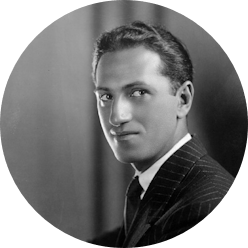
George Gershwin
September 26, 1898 - New York (USA) — July 11, 1937 - Hollywood (USA)
About
George Gershwin embodied the best of the “American dream”: born a poor son of immigrants, with tremendous talent he ascended to the highest echelons of American culture. He achieved fame and fortune with catchy pop songs like “Swanee,” hit stage works including Of Thee I Sing and the opera Porgy and Bess (many of these co-written with his lyricist brother Ira), and jazz-infused orchestral gems. Perhaps more than any other composer, he captured in sound the boisterous, bustling energy of the Roaring Twenties with iconic works like Rhapsody in Blue. Though his life was cut tragically short, he remains, in the words of Leonard Bernstein, “the incarnate American composer.”
Early Years
Tenement life
George Gershwin was born Jacob Gershwine in Brooklyn, New York to Jewish immigrant parents from Saint Petersburg. He spent much of his youth living in tenement buildings on Manhattan’s Lower East Side. When his parents bought a piano for his older brother Ira, it was George who fell in love with the instrument. He began studying with neighborhood teachers and found his first major musical influence with teacher Charles Hambitzer. After completing the ninth grade, Gershwin dropped out of school to pursue his career in music. This decision prophesied a lifelong restlessness in Gershwin, a perpetual striving to conquer new heights.
Tin Pan Alley
At the age of fifteen, Gershwin was hired as a “song plugger” in Tin Pan Alley, the famed collection of publishers and songwriters in New York City. Here he promoted other composers’ songs by performing them for prospective buyers. Not content to merely perform the music of others, he began composing his own songs. By the time he turned nineteen he had left plugging behind him. Inspired by composers like Jerome Kern, most known for the musical Show Boat, and Irving Berlin, composer of standards including “God Bless America” and “White Christmas” (like Gershwin’s parents, Berlin was a Russian immigrant), he set his sights on the Great White Way.
Early successes
At the age of twenty, Gershwin saw his first full score, for the musical La La Lucille, premiere on Broadway. That same year brought his first big songwriting hit, “Swanee.” Popularized by the singer Al Jolson, “Swanee” spent nine weeks at the top of the charts and sold millions of records. Amid this success, Gershwin already had his eye on the future. He began studying harmony, form, and orchestration with Edward Kilenyi and soon wrote his first classical compositions. The 1910s ended on a high note for Gershwin, a harbinger of the triumphant decade to come.
Making it big
The conclusion of the First World War ushered in a frenetic decade of optimism. The Roaring Twenties represented an era of modernity, innovation, and stark breaks with tradition. Developments in recording technology gave audiences unprecedented access to the latest music and films. One genre in particular benefited greatly from this proliferation: jazz. Originating among African Americans in New Orleans, jazz captured the imagination of a generation. In a beautifully unexpected testament to America’s melting pot spirit, a scrappy Jewish boy from the New York tenements became a leading voice of the Jazz Age.
The early Broadway musicals
Following the success of La La Lucille, Gershwin produced a string of musicals for the Broadway stage. Although 1921’s A Dangerous Maid never made it to Broadway, it marked the first full score he wrote with his brother Ira. Their breakthrough came in 1924 with the premiere of Lady, Be Good! Starring Fred and Adele Astaire, the show became a smash hit and introduced the standard “Fascinating Rhythm.”
The orchestral hits
“For a long time,” Gershwin wrote later in life, “as far back as my eighteenth year—I have wanted to work at big compositions.” The first of these, the miniature jazz concerto Rhapsody in Blue, remains his most famous instrumental work. It made Gershwin rich, earning him nearly a million dollars in royalties in its first decade. He moved to a penthouse on the Upper West Side, eventually living next door to Ira so they could collaborate without wasting time commuting. Following the success of Rhapsody, Gershwin quickly composed the Piano Concerto in F Major; he played the piano part at the premiere of both works.
He completed much of the tone poem An American in Paris while in Europe, where he spent time with the French composer Maurice Ravel. Like Gershwin, Ravel was fascinated by jazz and incorporated it into several of his later works including his Piano Concerto in G Major and the Piano Concerto for the Left Hand.
Gershwin asked Ravel for composition lessons but was denied. Ravel supposedly replied, “Why would you want to be a second-rate Ravel when you can be a first-rate Gershwin?” He wrote Gershwin a letter of introduction to Nadia Boulanger, the prolific teacher whose students included Aaron Copland, Philip Glass, and Daniel Barenboim; she rejected Gershwin for similar reasons. Undeterred, Gershwin continued to refine his craft. He studied with a succession of teachers including Rubin Goldmark (one of Antonín Dvořák’s teachers and later Head of Composition at the recently renamed Juilliard School), Wallingford Riegger, Henry Cowell, and Joseph Schillinger.
An operatic breakthrough
Gershwin made his first foray into opera in 1922 with the one-act Blue Monday. The work was unsuccessful—given only a single performance on Broadway—but this opera “à la Afro-American” proved an important precursor for Porgy and Bess. That “folk opera,” completed in 1935, is perhaps Gershwin’s greatest work. To this day it remains a cornerstone of the American opera repertoire.
Twilight in Hollywood
George and Ira traveled to Hollywood at the end of 1930 to write music for the film Delicious. Years later, the pair signed a contract with RKO film studios and installed themselves in a rented house in Beverly Hills. The collaboration produced the Fred Astaire vehicles A Damsel in Distress and Shall We Dance, but it would be tragically short lived. After months spent suffering from dizzy spells and changes in mood, George fell into a coma. He was diagnosed with a brain tumor and died a few days later following an unsuccessful emergency surgery.
Gershwin’s works
Rhapsody in Blue
Gershwin composed Rhapsody in Blue in early 1924 at the request of bandleader Paul Whiteman. The piece, a quasi-concerto for piano and small orchestra, premiered that year in New York City in a concert of jazz and classical music titled “An Experiment in Modern Music.” Today, the work is credited for bringing jazz into the concert hall.
Some of its musical ideas came to Gershwin during a train ride: “I heard it as a sort of musical kaleidoscope of America, of our vast melting pot, of our unduplicated national pep, of our metropolitan madness.” He later called the piece “my start in the field of more serious music.” With its iconic upward clarinet glissando and boisterous energy, Rhapsody in Blue truly embodies the spirit of the Jazz Age.
Piano Concerto in F
After the success of Rhapsody in Blue, Gershwin composed his Piano Concerto in F Major the following year. Its structure follows the traditional three-movement scheme of a concerto, though its musical idioms are anything but. Gershwin called the work, which draws from ragtime, jazz, and the blues, “an orgy of rhythms.” More than a century after Gershwin gave its premiere performance at Carnegie Hall, the Concerto in F remains one of the most popular 20th-century piano concertos among artists and audiences alike.
An American in Paris and Cuban Overture
Gershwin composed two symphonic poems: the Cuban Overture and An American in Paris. He composed much of the latter while visiting Europe, including a stay in Paris. To capture the bustling metropolitan spirit in what he called a “rhapsodic ballet,” Gershwin imported taxi horns from Paris to incorporate into the piece. An American in Paris was later adapted into an Academy Award-winning musical film starring Gene Kelly.
Of Thee I Sing
The Gershwins’ musical Of Thee I Sing premiered on Broadway in 1931. A political satire in the tradition of Gilbert and Sullivan, it was one of the most sophisticated works of American musical theatre up to that time. The show won the Pulitzer Prize for Drama, the first musical to do so (George initially received no recognition since the prize didn’t take music into consideration, but the Pulitzer committee gave him an honorary award at his centenary).
Porgy and Bess
When Gershwin first read the 1925 novel Porgy, a book by obscure South Carolina author DuBose Heyward, he was captivated by the tale of a disabled black beggar in Charleston. He immediately wrote to Heyward suggesting they collaborate on an operatic version. Nearly a decade later, Porgy and Bess premiered in Boston. Heyward wrote the libretto, though Ira contributed some of the lyrics. The opera broke ground for its depiction of African American life and its cast of classically trained African-American singers. As with many of Gershwin’s other classical works, Porgy won renown for merging separate musical spheres—jazz, blues, and folk with opera—into a coherent work. This “Great American Opera” spawned several hits that have become standards in their own right: “Summertime,” “My Man’s Gone Now,” “It Ain’t Necessarily So,” and “I Loves You, Porgy.”
Gershwin the songwriter
George and Ira Gershwin completed over a dozen stage musicals together, as well as film musicals and Porgy and Bess. Their prolific writing partnership produced numerous hits, and many of their songs have become staples of the Great American Songbook. While most of the shows are rarely performed today, these songs remain popular jazz standards. From the tender strains of love songs like “Someone to Watch Over Me” to the clever wordplay of “Let’s Call the Whole Thing Off” from the film Shall We Dance, the Gershwins’ catalog has been covered by the greatest singers of the past century including Ella Fitzgerald, Billie Holiday, and Frank Sinatra. The chord progressions George wrote for “I Got Rhythm” became the basis for numerous jazz compositions.
Gershwin's influence on classical music
Since Gershwin’s untimely death, several American composers—many of them Jewish, like Gershwin—emerged as potential successors and champions of his music. Leonard Bernstein conducted Rhapsody in Blue from the piano for decades and seamlessly incorporated jazz and Caribbean dance idioms into musicals such as On the Town and West Side Story. Stephen Sondheim, who wrote the lyrics to West Side Story as well as many of his own musicals, used Gershwin’s eclectic fusing of genres as inspiration for his own compositions. Sondheim considered Porgy one of the great works of the American theater; he once broke down in tears at sight of Gershwin’s manuscript for the opera.
Composer, conductor, and pianist André Previn followed in Gershwin’s footsteps, incorporating jazz elements into many of his classical works including the opera A Streetcar Named Desire. He won an Academy Award for Best Scoring of a Musical Picture for Porgy and Bess; he also won a Grammy for his work on the film. Throughout his career, conductor Michael Tilson Thomas has frequently performed and recorded Gershwin’s orchestral works.
George Gershwin’s fascinating rhythms and endlessly singable melodies provide a sonic time capsule of the Jazz Age. He helped introduce jazz, blues, and other American musical genres into the concert hall, brilliantly weaving these rich musical traditions into the fabric of American classical music. As a prolific writer of hundreds of songs, he enriched the diatonic idiom of popular music with fresh and exciting harmonic modulations and chromaticism. “True music,” he wrote, “must reflect the thoughts and aspirations of the people and time. My people are Americans. My time is today.”
George Gershwin: timeline of key dates
- 1896: Ira Gershwin is born in Manhattan, New York.
- 1897: George Gershwin is born Jacob Gershwine in Brooklyn, New York.
- 1901: The Victor Talking Machine Company, one of the earliest phonograph manufacturers, is founded in the United States.
- 1903: Enrico Caruso makes his debut with the Metropolitan Opera. Russian pianist Vladimir Horowitz is born.
- 1904: Madama Butterfly by Giacomo Puccini premieres at La Scala.
- 1905: Richard Strauss’s scandalous opera Salome premieres in Dresden.
- 1906: Dmitri Shostakovich is born. Catastrophic San Francisco earthquake occurs.
- 1908: Charles Ives composes The Unanswered Question. Claude Debussy’s La mer premieres. Olivier Messiaen is born. Conductor Herbert von Karajan is born. Pablo de Sarasate dies. Nikolai Rimsky-Korsakov dies.
- 1911: Legendary American blues musician Robert Johnson is born. Virtuoso theremin player Clara Rockmore is born. Composer Bernard Herrmann, most known for his collaborations with director Alfred Hitchcock, is born. Gustav Mahler dies.
- 1912: Premiere of Arnold Schoenberg’s melodrama Pierrot lunaire. Sinking of the RMS Titanic in the North Atlantic Ocean.
- 1913: Stravinsky’s ballet Rite of Spring premieres in Paris after a commission from impresario Sergei Diaghilev for his Ballets Russes..
- 1914: The assassination of Archduke Franz Ferdinand in Sarajevo on 28 June precipitates the First World War, which begins one month later.
- 1918: Debussy dies of colon cancer at the age of 55. World War I ends on 11 November with the signing of the Armistice.
- 1924: Rhapsody in Blue premieres in New York City. A key composition of the Jazz Age, it has become one of the most recognizable pieces of American classical music.
- 1925: The Piano Concerto in F premieres at Carnegie Hall with Gershwin performing the piano solo.
- 1928: An American in Paris, Gershwin’s jazz-influenced tone poem, premieres at Carnegie Hall. Boléro, one of Maurice Ravel’s most famous compositions, premieres at the Paris Opéra.
- 1929: The Wall Street crash of October 1929 instigates the Great Depression.
- 1931: Gershwin’s Broadway musical Of Thee I Sing premieres. It becomes the first musical to win the Pulitzer Prize for Drama the following year.
- 1933: Adolf Hitler appointed Chancellor of Germany.
- 1935: Gershwin’s sole opera, Porgy and Bess, premieres in Boston.
- 1937: George Gershwin dies of a brain tumor at the age of 38 in Los Angeles. Maurice Ravel dies at the age of 62.