


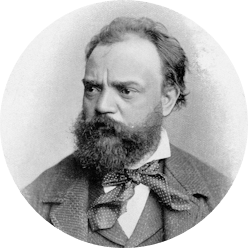
Antonín Dvořák
September 8, 1841 - Nelahozeves (Czech Republic) — May 1, 1904 - Prague (Czeck Republic)
About
Introduction
Who Was Antonín Dvořák?
“Truly, I mean when I say to you, the music of the future must be rooted in the melodies of the people.” – Antonín Dvořák
A leading figure of post-Romantic music, Antonín Dvořák played a vital role in reviving folk and popular music influences within the symphonic tradition. Deeply rooted in the culture of his native Bohemia, he was the first composer to blend the melodies and rhythms of Slavic folk music into classical forms in a way that sounded pleasant to the ears. His distinctive style even made its way across the Atlantic, shaping the development of American music through his seminal New World Symphony.
Dvořák’s Role in Music History
A masterful weaver of melodies and fearless arranger, Dvořák transformed music to its limits. He drew inspiration from folk songs and integrated them seamlessly into European symphonic forms. By merging two worlds that had long existed separately—the highbrow and the popular—he created a style that was lyrical, powerful, and instantly accessible to all. His compositional style paved the way for a new generation of composers, particularly in the United States.
Discover His Life and Work
Dvořák was born in his native Bohemia, but later traveled across Europe before eventually coming to America. Taking in new cultures and sounds, Dvořák’s music reflects this myriad of experiences, leaving an indelible mark on his music. After returning home, he explored new stylistic directions and devoted himself to teaching at the Prague Conservatory, but continued to follow a simple and quiet life. Explore the works of this composer who surprisingly occupied two opposing roles— traditionalist and visionary—on medici.tv!
Biography: From a Bohemian Inn to America
Childhood and Growing up in Europe
Antonín Dvořák was born on September 8, 1841, in the small Bohemian village of Nelahozeves, now part of the Czech Republic. His father, a butcher, innkeeper, and amateur musician, hoped his son would follow in his footsteps, but Dvořák’s musical talent begged to differ and quickly became apparent. More interested in music than in lessons in German, he was spellbound by the folk songs of his homeland, which had preserved their Bohemian identity despite the growing German influence in the region. When Dvořák turned 15, he left for Prague on his teachers’ advice to study organ. To make ends meet, he performed in inns and gave music lessons, eventually joining the Prager Kapelle orchestra as a violist. There, he played under the batons of renowned masters such as Wagner and Smetana. The latter recognized his talent and opened up the musical floodgates: Smetana introduced him to Prague’s musical circles, who helped pivot Dvořák towards his passion for composition. His early works, being his first two symphonies and opera Alfred, garnered local acclaim and allowed him to settle down with his wife, Anna. They had nine children together.
Early Career as a Composer
Despite initially not being known outside of Bohemia, Dvořák’s opera The Stubborn Lovers earned him his first major success in 1874. That same year, he received a grant from the Austrian government after submitting his Symphony No. 3 to a jury composed of prominent musicians. In Vienna, he met Johannes Brahms, who was so impressed by Dvořák’s talent that he introduced him to his publisher and promoted his music in Viennese circles. Soon Dvořák’s works were popular enough to reach England, where he conducted performances of pieces like his Stabat Mater. His ever-expanding reputation even caught the eye (or ear!) of Pyotr Tchaikovsky, who invited him to tour Russia. The Slavonic Dances (Op. 46 and 72) were a runaway success across Europe and Russia, establishing Dvořák as a major composer. Proud of staying true to his folk roots, he became an ambassador for a classical music deeply enriched by folk traditions.
Journey to the United States
In 1892, Dvořák accepted an invitation to lead the National Conservatory of Music in New York City, where he was welcomed as a hero of classical music. Fascinated by the sounds of his new environment, he could not stop listening to Black spirituals and Native American melodies. These influences inspired one of the most popular symphonies of today: Symphony No. 9 in E minor, “From the New World.” More than just a simple reflection of his American experience, the New World Symphony represented a musical innovation that united popular, folk, and classical traditions in a revolutionary and moving way.
As a teacher, Dvořák fervently preached the merits of his fusion of influence to young composers that we still listen to today, such as Gershwin and Copland. He encouraged them to listen to their own popular culture for the melodies, rhythms, and syncopations that would inspire them to craft their own musical style. In America, this meant learning from the complex harmonies of Black spirituals. “The future of music in this country lies in the hands of Black musicians,” he told the American press.
Final Years and Musical Legacy
When Dvořák returned to Bohemia in 1895, he resumed his post as professor at the Prague Conservatory and eventually retired to his home on the peaceful banks of the Vltava River. It was there, surrounded by nature, that he found the serenity he needed to compose some of his finest chamber works: during this period, he completed his final opera, Rusalka, and turned his attention towards symphonic poems such as The Water Goblin, The Noon Witch, and The Golden Spinning Wheel. In these works, he experimented with a narrative technique known as “intonations,” a style that would later influence fellow countryman Leoš Janáček. When Dvořák passed away in 1904, he left behind an immense legacy of 189 works, including his magnificent Cello Concerto, Slavonic Dances, Symphony No. 9 “From the New World”, as well as numerous chamber pieces such as the “American” Quartet, and no fewer than nine operas.
Dvořák’s Most Famous Works
Symphony No. 9 “From the New World”
The crown jewel of Dvořák’s oeuvre is his “New World” Symphony. Composed in 1893, it was inspired by Black spirituals and Native American melodies, which he took and then blended with the unmistakable Slavic sounds of his homeland. Today, it remains one of the most frequently performed symphonies in the concert repertoire and one of the most recognizable works of classical music more generally.
Slavonic Dances
The Slavonic Dances were key in ushering in Dvořák international fame. Inspired directly from the folk rhythms of Bohemia, these works combine rhythmic vitality, diverse motifs, and irresistible melodic charm. You can explore his Slavonic Dances, Op. 46 and Op. 72 in their full splendor in the medici.tv catalog.
Cello Concerto in B minor
Dvořák’s Cello Concerto is one of the most famous works ever written for the instrument. Its sweeping lyricism and emotional depth continue to captivate cellists and audiences alike. Hidden within the notes is an homage to a melody his sister-in-law, Josefa, loved—a girl with whom he was in love throughout his youth.
Other Works
Concerning chamber music, Dvořák’s “American” Quartet, composed in 1893 during his stay in Iowa, reflects the influence of Black and Native American melodies while maintaining a European classical structure. Inspired by the American landscapes, Dvořák finished it in only 13 days! Another highlight of his chamber works is the Dumky Trio in E minor, Op. 90 (1891), an unusual piece built on the dumka—a Slavic musical form that alternates between introspective and exuberant moods. Among his operas, Rusalka takes the cake as his most popular opera, probably thanks to its timeless aria, “Song to the Moon.” You can explore Dvořák’s most beautiful compositions and discover new Czech composers in our playlist dedicated to Czech music.

