


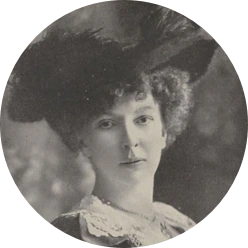
Cécile Chaminade
August 8, 1857 - Batignolles-Monceau — April 13, 1944 - Monte Carlo
About
The meteorically successful Cécile Chaminade, nicknamed “my little Mozart” by Georges Bizet, was a trailblazer multiple times over: a prolific composer, a virtuoso pianist on both sides of the Atlantic, and an iconic female figure in a musical world still completely closed to women, the uncompromising Chaminade took no prisoners.
Birth and upbringing
Early years in Paris
Cécile Louise Stéphanie Chaminade was born on August 8, 1857, in Paris, into a bourgeois family who surrounded her with music from her early days. Her father played the violin, and her mother was an accomplished pianist and singer. Little Cécile composed her first pieces even before she could read or write properly. At barely 12 years old, she performed some of her compositions before Georges Bizet, who was immediately impressed by her talent.
Private musical education
Bizet strongly encouraged Cécile’s parents to enroll their daughter at the Paris Conservatory, but her father espoused patriarchal values and was firmly opposed to her training as a professional musician: he viewed women’s musical activity as acceptable solely within a context of leisure. A compromise was finally reached, and she studied privately with teachers from the Paris Conservatory: Félix Le Couppey for piano, Augustin Savard for harmony, and Benjamin Godard for composition. She undertook a curriculum nearly identical to that of the Conservatory, but behind the closed doors of bourgeois salons.
A young prodigy with big-name support
Bizet was not the only major figure to recognize Cécile’s potential. The Chaminades regularly hosted musical evenings in their salon, attended by Vincent d’Indy, Jules Massenet, Charles Gounod, Ambroise Thomas, Emmanuel Chabrier, and above all Camille Saint-Saëns, who would greatly aid Cécile Chaminade at the start of her career. These encounters shaped both her musical education and her network, allowing her to make a name for herself in the most influential circles of Parisian musical life.
Career as a composer and pianist
Success as a virtuoso pianist
In 1877, while her father was away on business, the young Chaminade took advantage of his absence to perform in public for the first time in a chamber music concert at the Salle Pleyel. The reception from the press and the public was enthusiastic, with critics praising her “beautiful technique and virtuosity.” In 1880, the Société Nationale de Musique programmed her Piano Trio in G minor, Op. 11, and in 1881, her Suite for Orchestra, Op. 20. 1888 was a special year for Chaminade: she simultaneously premiered her symphonic ballet Callirhoë at the Marseille Opera, her dramatic symphony Les Amazones, and her Concertstück for piano and orchestra in Antwerp — three ambitious works that unequivocally established her bona fides as a composer.
Publication of numerous piano pieces and songs
Following those high-profile premieres, Chaminade gained renown as a “salon composer” with a vast number of piano pieces and songs written for amateur pianists. These works were published and sold by the thousands, finding their way into the homes of pianists throughout France, England, and beyond. Among her most famous works are Automne, La Lisonjera, Les Sylvains, the Sérénade espagnole, and the art song L'Anneau d'argent. In 1902, she received a commission from the Paris Conservatory to compose the Concertino for Flute, Op. 107, for its annual competition. Although this piece remains one of her most frequently performed works worldwide, her catalogue totals over 400 works, including 200 piano pieces and around 150 songs.
Popularity with the general public
Far from limiting herself to academic circles, Cécile Chaminade wrote above all for the general public, whose tastes she understood with remarkable intuition. From the 1890s onward, she was one of the most popular and highest-paid female composers in France. Her elegant and melodious style is rooted in the Romantic tradition, and her piano pieces are full of nuance and virtuosity, while remaining accessible to broader audiences. Despite the condescending criticism of the gender-biased press, she did not waver in her position. Considering herself a composer like any other — rather than a “female composer” — Chaminade declared, “I do not believe that a composer’s gender has anything to do with the quality of their work.”
International recognition
Tours in Europe and the United States
Cécile Chaminade toured France, Belgium, Switzerland, and Great Britain, as well as Germany, Austria-Hungary, Romania, Bulgaria, Serbia, Greece, and Turkey.
During her 1896 tour of the Balkans, she even gave a charity concert in Athens to support the city’s conservatory. In England, she returned almost every June to give an annual concert and was invited by Queen Victoria to stay at Windsor. Upon the queen’s death, Chaminade’s Prelude for Organ was performed at her funeral.
Warm reception in the English-speaking world
For her first American concert in 1908, she performed the solo part of her Concertstück with the Philadelphia Orchestra. Chaminade also performed in 12 cities during this tour, including at New York’s Carnegie Hall, Boston’s Symphony Hall, and venues in the Midwest. At the height of her popularity in the early 1900s, her American admirers founded more than 200 “Chaminade Clubs.” These clubs, composed mainly of female pianists and music lovers, organized concerts, competitions, and scholarships for young musicians, and broadcast her works on local radio. These were not simple fan clubs; they embodied a movement of female solidarity centered around music.
A full-time working musician
Cécile Chaminade was a true exception in the musical landscape of her time. An exclusive contract bound her to her publisher, Enoch, ensuring the worldwide distribution of her works. Almost all of her compositions were published and financially successful during her lifetime. The “Scarf Dance” had sold over five million copies by the time of her death. In 1913, she became the first female composer to be admitted to the National Order of the Legion of Honor — a historic distinction crowning decades of silent struggle against the prejudices of an era that struggled to recognize talent beyond gender.
Final years and rediscovery
World War I marked a brutal turning point. Chaminade set aside her career as a composer to join the war effort, notably by helping to manage a London hospital. After the war, her music gradually faded from view. She lived increasingly in seclusion, selling her house in Le Vésinet, and gradually ceased her musical activities. Her last works date from 1928. In 1938, her left foot had to be amputated. She retired to Monte Carlo, where she was cared for by loved ones. She was touched by birthday wishes sent from all over the world thanks to a campaign organized by the American music magazine The Etude. Cécile Chaminade passed away on April 13, 1944, in relative obscurity. It was not until the 2000s that some of her works were unearthed, finally giving this pioneering figure the contemporary recognition she deserves.