


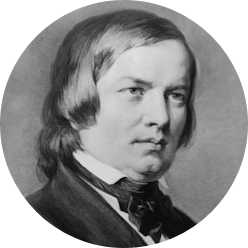
Robert Schumann
June 8, 1810 - Zwickau (Germany) — July 29, 1856 - Franckfurt am Main (Germany)
About
Robert Schumann (1810–1856) was a German Romantic composer, renowned for his piano works, song cycles, chamber music, and symphonies. Though he once seemed destined to become a great virtuoso pianist, an injury to his hand permanently redirected him toward composition and music criticism. A poet at heart and deeply steeped in literature, he composed music that was both intimate and expressive. His marriage to Clara Wieck, a child prodigy pianist, inspired him throughout his life and in his compositions. Despite a life marked by mental illness, Schumann left behind a strikingly forward-looking treasure trove of music and became a major point of reference for composers and performers who followed him, continuing to the present day.
Youth and education
Family circle and discovery of music
Robert Schumann was born on June 8, 1810, in Zwickau (Saxony), into a cultured middle-class family deeply devoted to literature and the arts. His father, August Schumann, was a bookseller, publisher, and translator specializing in Romantic literature. He was passionate about Jean Paul, Byron, Goethe, and Hoffmann, and raised his five children in a stimulating intellectual environment. From a very early age, Robert showed great artistic sensitivity: he wrote poems, created imaginary characters, and discovered his love for the piano at the age of seven. As a teenager, he was already composing his first pieces and harbored the dream of becoming a virtuoso pianist. Literature and music left a lasting mark on his childhood, and traces of poetry and fiction would resurface much later in his numerous compositions.
Moving to Leipzig, meeting the Wiecks, and early studies
In 1828, Robert Schumann moved to Leipzig to begin studying law, in accordance with his family’s wishes. However, he rarely attended his classes, preferring literary cafés and concerts. It was there that he met Friedrich Wieck, a famous piano teacher and renowned pedagogue. He began to study the piano seriously under his guidance and even moved into his home. At the Wiecks’ house, he met Clara, his teacher’s daughter, then nine years old, who would later become his wife and one of the greatest pianists of the 19th century. Friedrich Wieck immediately recognized Schumann’s talent and encouraged him to practice intensively. In his eagerness to progress quickly, Schumann used various devices to make his fingers more flexible, but this practice caused irreversible damage to his right hand, putting an end to his dreams of becoming a virtuoso pianist. This incident did not, however, drive him away from music; on the contrary, after the incident, he decided to devote himself entirely to composition and music criticism.
Abandoning performing career, first major piano compositions
As early as the 1830s, Schumann composed his first major works for piano, which are now considered the crown jewels of Romanticism. He composed cycles of miniatures (a series of short, independent pieces linked by a musical theme) such as Papillons (1831), Davidsbündlertänze (1837), and the famous Carnaval (1834–1835), in which he brought real and imaginary characters to life, much like in poems. These works, characterized by lyrical flourishes and daring harmonies, reveal a highly personal style from the very beginning of his career as a composer. It was also during this period that he developed his musical alter egos, Florestan and Eusebius, symbols of his passionate outbursts and introspective reveries.
Robert and Clara
The love story between Robert Schumann and Clara Wieck remains one of the most famous in music history. They met in Leipzig, at the Wieck family home. Clara was the daughter of Friedrich Wieck, Robert’s piano teacher. At the age of nine, she was already a piano prodigy, and over the years, the artistic admiration and affection they shared for one another blossomed into a deep love, which met with the fierce disapproval of Clara’s father. Before they could live out their love freely, they first had to endure a long legal battle to secure the right to marry. This ordeal only brought the couple closer together. They were finally married on September 12, 1840, when Clara was 21. Their romantic life was marked by intense artistic collaboration: indeed, the year 1840 is known in Schumann’s work as the “Liederjahr,” the year in which he composed more than 150 Lieder. Clara became his first performer as well as his greatest inspiration and a champion of his music, sharing his work throughout Europe. They ultimately had eight children. Despite the difficulties and Robert’s illness, their marriage remains for many observers one of the most beautiful stories of musical collaboration between a couple.
Artistic maturity
The Leipzig Years
From around 1830 to 1840, Schumann studied in Leipzig under Friedrich Wieck. He drew inspiration from literary and musical circles around him, with his networks helping Schumann to carve out a name for himself as a composer and music critic. In 1834, he founded the Neue Zeitschrift für Musik, a journal that allowed him to promote young talents such as Chopin and Felix Mendelssohn. After his marriage to Clara in 1840, he composed a large number of song cycles and his first symphonies.
Moving to Dresden
In 1844, Robert Schumann, suffering from nervous exhaustion, left Leipzig to settle in Dresden, where he sought creative refuge and greater peace. This period marked a turning point in his life: there he composed ambitious orchestral works, including Symphony No. 2 and the Manfred Overture, inspired by Byron. Dresden also offered him a more stable environment for his family and for Clara, who continued to play a central role in the conception and dissemination of his works. But nervous breakdowns, hallucinations, and depressive episodes became increasingly frequent.
Downturn and final years
In February 1854, as his crises and hallucinations intensified, Robert Schumann attempted suicide by throwing himself into the Rhine. Rescued by passersby, he was committed to the Endenich asylum near Bonn, where he remained for the last two years of his life, during which time he composed almost nothing. Separated from Clara, who was pregnant at the time of his commitment, he had virtually no further contact with his family until his death. Robert Schumann died on July 29, 1856, at the age of 46, leaving behind a poetic and innovative musical legacy that continues to inspire composers today and call back to the best of Romanticism.
The work of Robert Schumann, a major figure of Romanticism
Piano works
A virtuoso pianist in his youth, Schumann is primarily known as a composer of lavish piano works that have become staples of the classical repertoire.
Carnaval, Op. 9
Carnaval, Op. 9 (1835) is a cycle of brilliant and whimsical mini-pieces in which Schumann stages a musical masquerade ball. Each piece represents a real or imaginary character: Pierrot, Harlequin, Chopin, Paganini, but also Florestan and Eusebius, the two facets of his personality. Schumann plays with symbols, theatricality, and musical dialogues. This work is so rich in color, character, and inventiveness that it truly earns its place as one of the first great masterpieces of Romantic piano music.
Kinderszenen, Op. 15
The Kinderszenen (Scenes from Childhood), Op. 15 (1838), are thirteen short pieces that evoke childhood not through a child’s eyes, but those of a wistful adult who dreams of and revisits it. These deeply personal pieces embody the intimate and poetic Schumann, imbued here with a nostalgia unique to the subject of childhood. The seventh piece in this set, “Träumerei” (Dreaming), is one of the best-known pieces in the entire piano repertoire.
Symphonic Etudes, Op. 13
The Symphonic Etudes, Op. 13 (1834), are among Schumann’s most ambitious piano works. The name of the piece is not hyperbolic, as the piano takes on an impressively orchestral scope. Ranging from dazzling virtuosity to somber lyricism, the work explores a wide range of emotions. A challenge for any performer, this work is Romanticism for the piano at its finest.
Kreisleriana, Op. 16
Kreisleriana, Op. 16 (1838). At the height of his powers, Schumann composed Kreisleriana, which would become one of his best-known pieces. Inspired by the tormented Master Kreisler, a recurring character in the literature of E.T.A. Hoffmann, the eight pieces that make up the cycle alternate between passionate intensity and intimate reverie, reflecting Schumann’s own failing mental health. The writing is dense and nervous, with pronounced contrasts and palpable tensions. The work is visionary and reflects a darker, more profound Romanticism.
Orchestral works
Through his orchestral works, Schumann sought to establish himself within the great German symphonic tradition and bring his intimate musical world to audiences everywhere. He composed four symphonies, including the luminous Symphony No. 3, “Rhenish,” and the more introspective Symphony No. 2. His concertos for piano (Piano Concerto in A minor, Op. 54) and cello (Cello Concerto in A minor, Op. 129) have both become staples of the Romantic repertoire. Rather than spectacular orchestration, what Schumann sought to convey in these major works was profound expressiveness and poetic inspiration. Though sometimes criticized for their compact structure, his works remain profoundly original and modern for their time.
Lieder
Schumann’s favorite musical genre is undoubtedly the Lied. His sensitive nature is perhaps nowhere on better display than in his lieder, pieces of great emotional depth. The year 1840, often called Schumann’s “Liederjahr,” saw the creation of more than 150 songs, including the major cycles Dichterliebe, Liederkreis, and Frauenliebe und Leben. In these works, Schumann achieves a unique fusion of poetry and music: the piano is no longer merely an accompaniment but a mirror for the voice, carrying within it the hidden emotions of the text. The attention to detail, daring harmonies, and literary imagination became hallmarks not just of Schumann’s Lieder, but of German Romanticism as a whole. He would go on to profoundly inspire Wolf, Mahler, and Strauss.
Chamber music
Following his “Liederjahr” in 1840, Schumann experienced a “year of chamber music” in 1842. During this fruitful period, he composed some of his most renowned masterpieces, such as the Piano Quintet, Op. 44, the Piano Quartet, Op. 47, and the Piano Trios, Op. 63. These intensely lyrical works feature bold and surprising harmonies. Schumann writes the piano in front and center, almost like an orchestral role, while developing an intimate dialogue with the string instruments. Expressive and poetic, his chamber music left a lasting mark on the Romantic repertoire and influenced other legendary composers like Brahms and Fauré.
Opera
Long nurturing a deep desire to create a great German lyric drama, Schumann composed only one opera, Genoveva, in 1850. Inspired by a medieval legend, Genoveva features Romantic music faithful to his poetic style. However, Schumann was more at ease with free, intimate, and literary forms, and felt out of his depth when it came to the theatrical demands of opera. Despite its musical beauty, Genoveva was not a success and remains today a rare work, yet one that should not be overlooked in understanding Schumann’s dramatic ambition.
Schumann’s lasting influence
The legacy of Robert Schumann’s genius extends far beyond his own time and has left a lasting mark on the evolution of Western music. His poetic piano compositions paved the way for composers like Grieg, Fauré, Rachmaninov, and Scriabin, who adopted his signature harmonic lyricism. In the vocal realm, his song cycles became a model for Wolf, Mahler, and Strauss, who continued to fuse poetry and music. He also was a strong influence on Johannes Brahms, whom he supported from the very beginning of his musical career. Finally, his critical and theoretical perspective helped shape the Romantic aesthetic itself: Schumann became the figure of the composer-poet, visionary and sensitive, and embodied the musical modernity of the future.
Robert Schumann: timeline of key dates
- June 8, 1810: Born in Zwickau
- March 31, 1828: Moved to Leipzig; studied law
- October 1, 1830: Official start of his studies with Wieck
- April 2, 1834: Founding of the Neue Zeitschrift für Musik
- 1835: Publication of piano suite Carnaval, Op. 9, a poetic and visionary self-portrait
- 1840: The year of the Lieder, composition of song cycle Dichterliebe, Op. 48, the incarnation of German Romanticism
- September 12, 1840: Marriage to Clara Wieck
- December 1844: Moved to Dresden
- December 4, 1845: Composition, with Clara (now Schumann), of the Piano Concerto in A minor, Op. 54
- November 2, 1850: Composition of Symphony No. 3, “Rhenish”
- February 27, 1854: Suicide attempt and confinement in Endenich
- July 29, 1856: Death of Robert Schumann
