


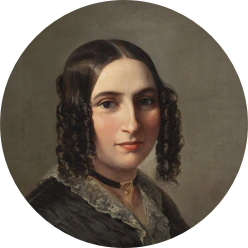
Fanny Mendelssohn
November 14, 1805 - Hamburg — May 14, 1847 - Berlin
About
Aside from her brilliant compositions, German composer Fanny Mendelssohn (1805–1847) was known for her dazzling piano virtuosity. You may be familiar with her older brother, composer Felix Mendelssohn, but did you know that Fanny possessed just as much genius (if not more, some critics argue)? While Felix globetrotted, Fanny remained confined to gender roles during the Romantic period, which dictated that upper-class women were not to pursue careers in music. Tragically, no amount of talent could have freed her from the limits imposed upon women in the 19th century.
Youth and education
Birth and family background
Fanny Cäcilie Mendelssohn Bartholdy was born on November 14, 1805, in Hamburg into a wealthy and well-educated Jewish family. She was the daughter of Lea and Abraham Mendelssohn Bartholdy and the granddaughter of the Enlightenment philosopher Moses Mendelssohn. In 1811, the family moved to Berlin and were quickly absorbed into the intellectual milieu of the Prussian capital. Her family put forward every effort to engage in all that was intellectual and artistic. Every Sunday, her parents organized private concerts that brought together Berlin's artistic elite, putting the Mendelssohn children in touch with the greatest musicians of their time, a privilege afforded to close-to-none.
Early talent and musical education
Fanny showed extraordinary promise whenever her fingers hit the piano keys. Her mother Lea was her first piano teacher, being an accomplished musician herself. What was she doing at 12 years old? Only performing Johann Sebastian Bach's 24 Preludes from The Well-Tempered Clavier—from memory. Spectators at the private concert were amazed by her young age yet seemingly-unlimited memory and technique. Her musical education continued with the greatest masters of the time, such as Ludwig Berger and Carl Friedrich Zelter, who was also her brother Felix's teacher. Zelter, who was the director of the Sing-Akademie in Berlin, gave both children the same training in composition, which was unusual at the time. Legend has it that during a visit to Weimar, Goethe recognized Fanny’s musical talent as being equal to and even surpassing that of her younger brother. Felix knew not to play up his ego—he readily admitted that his sister was the better pianist, making her his principal musical advisor and confidant throughout his life.
Her first compositions
Fanny began composing when she was 14. In 1819, she and Felix composed a Lied together that they later gifted to their father. After that first composition, writing music became Fanny’s lifeline. She mainly wrote Lieder for soprano and piano, but also pieces for solo piano. However, the limits imposed on her ambition were already hardening. In 1820, her father wrote her a harsh letter: “Music may be a profession for Felix, but for you it can never be more than an ornament, never the basis of your existence.” His injunction weighed heavily on Fanny's mind and served to affirm the belief that she would never be a professional musician.
A career hampered by social conventions
Familial opposition to her public career
Fanny continued to face adamant pushback from her family concerning expanding her musical training into a career. For a woman hailing from Berlin's upper middle class, music could only be a pastime, never a professional means to an end.
Her father, and later brother Felix, forbade her from publishing her compositions or performing in public concerts. Felix was well aware of her genius, but did not challenge the status quo. In a letter from 1837, he wrote: “Fanny has neither the inclination nor the vocation to become an author. She is too much of what a woman should be.” The patriarchal misogyny rampant in her family stifled Fanny’s genius and need to create in favor of a traditional domestic role. Between 1822 and 1830, several of Fanny's Lieder were published under Felix's name, in his Opuses 8 and 9. Italien became a particularly popular one.
Her marriage to Wilhelm Hensel
In 1829, Fanny married Wilhelm Hensel, a painter at the Prussian court. The couple had one son, Sebastian Ludwig Felix, who later wrote a biography of the Mendelssohn family based on his mother's diaries and letters. Unlike Fanny's father and brother, Wilhelm Hensel was nothing if not supportive of her musical career. He encouraged Fanny to do everything that had been forbidden: composing, publishing, even performing. A perfect example: Fanny herself composed the music for their wedding ceremony. Thanks to Wilhelm, she was finally free to follow her passion, even if it was still confined to the private sphere.
After her mother's death in 1843, Fanny took over the family home and took this opportunity to organize what would become the famous Sunday morning concerts at the Mendelssohn residence in Berlin. These private musical events quickly became the hottest joint in Berlin's artistic scene, and Fanny was front and center: she conducted the orchestra and performed works by Bach, Beethoven, and Mendelssohn (both Felix and Fanny, to select audiences).
An artist praised by her peers
Although confined to the private sphere, Fanny still managed to make an impression on musical life. In 1839, she traveled to Italy with her husband and stayed in Rome for more than six months. This trip marked a turning point in her artistic and personal life: it was there that she met the French composers Charles Gounod, then a young winner of the Prix de Rome, and Hector Berlioz, already famous at the time. Gounod may have been one of Fanny’s biggest fans—he described her as an unforgettable musician, a pianist of a rare caliber, and a woman of superior intelligence. She introduced him to the piano music of Bach and Beethoven, and this encounter had a lasting effect on his life.
In 1846, Fanny was 40 years old and ready to change her own life. She decided to publish her compositions, despite anticipated social backlash. Her first collections appeared under the name “Fanny Hensel geb. Mendelssohn Bartholdy” (Fanny Hensel born Mendelssohn Bartholdy). They contained the Sechs Lieder, Op. 1, the Vier Lieder für das Pianoforte, Op. 2, and the Gartenlieder, Op. 3. Any backlash she might’ve gotten was quickly overshadowed by glowing reviews and calls for commissions. After being relegated backstage for far too long, Fanny was finally able to pursue the musical career she had hoped for.
The work of Fanny Mendelssohn
Publication of her works and rediscovery
On May 14, 1847, during a rehearsal of Felix's oratorio Die erste Walpurgisnacht for one of his Sunday concerts, Fanny had a stroke at the piano. She died that same evening, at the age of 41. Her brother Felix was left devastated, and followed her to the grave six months later, also from a stroke.
Ironically, after a lifetime of turning a blind eye towards her musical talents, Fanny's family submitted her Piano Trio in D minor, Op. 11 to Breitkopf und Härtel for publication in 1850 after her death. For more than a century, Fanny Mendelssohn's work fell into oblivion. Her family preserved her manuscripts, of which were later added to the Felix Mendelssohn archives at the Berlin State Library in 1965.
Fanny Mendelssohn’s work reentered the limelight thanks to the emergence of feminist studies in musicology in the 1970s. In 1976, MGG (Musik in Geschichte und Gegenwart), the prestigious music dictionary, finally added her entry, while admitting that her oeuvre of more than 400 pieces remained largely unexplored.
In the 1980s and 1990s, musicians and researchers dedicated themselves to researching Fanny’s works. Recordings of her works came out, notably on the CPO and Thorofon labels. Published in 2000, the Hellwig-Unruh catalog lists 466 compositions by Fanny. Today, she is finally recognized as one of the great composers of German Romanticism.
Her main works
Fanny Mendelssohn's wide-ranging catalog comprises 466 works, including nearly 250 songs for soprano and piano, more than 120 pieces for solo piano, chamber music, cantatas, and oratorios. She often featured texts by contemporary poets, such as Joseph von Eichendorff (20 texts), Johann Wolfgang von Goethe, and Jean-Pierre Claris de Florian. Her husband Wilhelm also wrote her around twenty poems, which she set to music. Here are some of her beloved works:
Das Jahr, H. 385
Composed in 1841, Das Jahr is undoubtedly the pinnacle of Fanny's oeuvre. Inspired by her séjour in Italy, her cycle of twelve pieces for piano represents each month of the year. Each piece is a vignette of the month’s atmosphere and associations, both in general and according to Fanny’s interpretation. This work highlights Fanny's storytelling talent and her ability to translate emotions and landscapes into musical melodies.
Piano Trio in D minor, Op. 11
Composed in 1846 as a birthday gift for her sister Rebecka, the Trio in D minor is considered to be one of Fanny's keystone pieces. This trio for piano, violin, and cello demonstrates not only her virtuosity, but also her chamber music sensibilities and ability to score for small music ensembles without overpowering each instrument. Instead, the work delicately balances the voices of the three instruments in such a way that their unique timbres can be appreciated in tandem.
The Lieder
The first piece she wrote was a Lied, so it comes as no surprise that the Lieder are at the center of Fanny's compositional focus. Her Sechs Lieder, Op. 1, published in 1846, brings to light her intertwining of poetry and music, creating lyrical and deeply moving vocal works in its wake. Each song is a perfectly-curated experience and expresses a plethora of feelings with great subtlety. Felix himself acknowledged that his sister's Lieder surpassed anything he knew or could write.
The Gartenlieder (“Garden Songs”), Op. 3, also published in 1846, are a collection of a cappella choruses for four voices, inspired by nature and gardens. These pieces are appreciated for their harmony and elegant simplicity.
Choral and sacred works
Fanny also composed major choral works, including the Oratorium nach Worten aus der Bibel (Oratorio on Words from the Bible), which was performed anew in concert in 1984 after more than a century of obscurity. She also left behind several cantatas and sacred music pieces that foreground her polyphonic writing.