


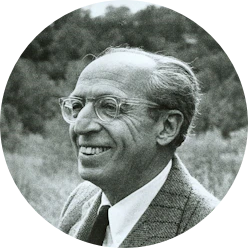
Aaron Copland
November 14, 1900 - New York — December 2, 1990 - Tarrytown
© John Ardoin
About
A monumental figure in 20th-century classical music, Aaron Copland (19001990) seamlessly blends European modernism with folk traditions, creating a sound that is synonymous with American musical identity. As a composer, conductor, and teacher, he certainly wore many hats (and all of them suited him!), allowing him to create a recognizable musical language that transports listeners from the seats of the concert hall straight into the vast spaces of America's natural landscapes. His biography tells the story of an exceptional career that transformed the course of American classical music.
Early life and education
Childhood and musical discovery
Born on November 14, 1900, to a family of Lithuanian Jewish immigrants in Brooklyn, Aaron Copland and music went hand in hand at an early age: as the youngest of five children, his older sister Laurine gave him his first piano lessons. At 13 years old, his mind was already set on becoming a composer—quite an unusual ambition for a young man from his modest social background. But his determination proved steadfast and led him to study with Rubin Goldmark, a respected composer in New York.
Studies in New York and Paris
In 1921, Aaron Copland reached a turning point in his musical training: he left for Paris and enrolled at the American Conservatory in Fontainebleau. Fate saw to it that he met his future mentor, the renowned Nadia Boulanger, at the conservatory. Her teachings would prove indispensable to his artistic development, as is the case for many musicians under her tutelage. She encouraged him to develop his unique compositional voice, while still ensuring that he followed rigorous training and mastered all the ins and outs of composition. Copland studied with Boulanger for three years, yet Boulanger's influence manifested throughout his career, and echoes of it can be found in his clarity of ideas and sense of structure.
His early works
Upon returning to the United States in 1924, Copland composed his first significant works, thanks to the influence of European modernism and jazz. These pieces included his Symphony for Organ and Orchestra (1924), with none other than Nadia Boulanger seated at the organ at its premiere. The work was sensational, with conductor Walter Damrosch declaring, “If a young man of twenty-three can write a symphony like this, in five years he'll be ready to commit murder!” Yet this bold remark perfectly characterizes Copland’s music: audacious and modern. During the same period, he also embraced the syncopated jazz rhythms in works such as Music for the Theater (1925) and his Piano Concerto (1926).
An American composer
The influence of jazz, folk, and American popular music
In the 1930s, Aaron Copland risked entering a new musical territory: modernism. Fearing that the modernist musical style risked isolating the general public, Copland decided to work on creating a more accessible style and turned towards American musical traditions. Jazz, folk songs, Protestant hymns, and popular melodies all wove their way into Copland’s rich musical fabric to create a sound that struck a chord (literally) with Americans. This fusion of European classical tradition and American folk heritage became his unique knack. In his own words, he sought to compose “music that would immediately be recognizable as American.”
His iconic works from the 1930s and 1940s include Appalachian Spring, Billy the Kid, and Rodeo. This fruitful period elevated Copland’s status as a world-renowned composer. Billy the Kid (1938), a ballet commissioned by Lincoln Kirstein, follows the (mis)adventures of the American West’s most famous outlaw, complete with melodies reminiscent of cowboys and wide, open expanses. Rodeo (1942), created for choreographer Agnes de Mille, captures the rebellious spirit of rural America with its famous “Hoe-Down.” But it was not until Appalachian Spring (1944), composed for Martha Graham, that established Copland as the voice and soul of America. Evoking the lives of Pennsylvania pioneers with its delicate and bright score, Appalachian Spring saw him take home the Pulitzer Prize in 1945. At the same time, his Fanfare for the Common Man (1942), composed in the midst of World War II, became an anthem to democracy and the ordinary man, with its dazzling brass and strong percussion.
Aaron Copland, musician and educator
Beyond composing, Copland was committed to expanding access to American musical life. He organized concerts, founded the Copland-Sessions Concerts with Roger Sessions to promote contemporary music, and taught at various institutions, including the Tanglewood Music Center, which he helped establish in 1940. Complementing his contributions to musical education were his public-facing works. His most notable works, What to Listen for in Music (1939), and Music and Imagination (1952), brought classical music into the home of the regular American. Copland was a firm believer in sharing knowledge, both as a composer and a member of the musical community, to help audiences discover and appreciate their compositions.
Career and recognition
Compositions for orchestra, ballet, and film music
Copland was everywhere. In orchestral halls, works such as his Third Symphony (1946) (featuring Fanfare for the Common Man) highlight the American symphonic repertoire. On the ballet stage, his scores revolutionized the genre in America and inspired generations of choreographers. And Copland's versatile compositions didn’t just stay on stage—they made it to the big screen. Hollywood has him to thank for remarkable film scores, including Of Mice and Men (1939), Our Town (1940), and The Heiress (1949), the latter of which even earned him an Oscar. His cinematic work profoundly influenced the aesthetics of American film music, establishing practices that can still be found today in westerns and films depicting rural America.
Awards and honors
Aaron Copland rode the wave of popular success until he finally earned official recognition. In addition to the Pulitzer Prize for Appalachian Spring, Copland received the Oscar for Best Original Score in 1950. In 1964, he was honored with the Presidential Medal of Freedom, the highest civilian award in the United States. The National Medal of Arts was bestowed upon him in 1986 in recognition of an inimitable career spanning over sixty years. He also received numerous honorary doctorates and became a member of the American Academy of Arts and Letters. These distinctions recognized not only his exceptional talent, but also his role in establishing a tradition of American classical music.
Final years and legacy Death in 1990
In the last decades of his life, Aaron Copland was less active as a composer but still chose to conduct his own works worldwide. He continued exploring new musical languages such as serialism, evident in some of his compositions from the 1950s and 1960s. His final opus, Proclamation for Piano (1982), concluded an impressive catalog of over 100 works. He passed away on December 2, 1990, in New York City at the age of 90, leaving behind an immense legacy. The news of his death was mourned by voices around the world as the loss of one of the greatest composers of the 20th century.
Popular music, today, and tomorrow
More than 30 years after Aaron Copland's death, his music is still being performed in concert halls and beyond—and it hasn’t lost any of its resonance with audiences, even after all these years. Appalachian Spring, Fanfare for the Common Man, Rodeo, and Billy the Kid are regularly featured in the programs of symphony orchestras around the world. Not only that, but his works surround us in our daily lives: they can be heard at official ceremonies, in advertisements, in documentaries about the United States, and even in popular music. How did he achieve such enduring popularity? Part of the reason is due to Copland's unique ability to capture the essence of what defines the American spirit, but when coupled with his seemingly timeless music, it’s no surprise that it continues to be played today.
Aaron Copland achieved what he had set out to do: create a distinctly American musical sound on par with the great European musical traditions. An American composer par excellence, a generous teacher, and a cultural visionary, Copland remains a leading figure in American classical music, whose influence continues to be felt far beyond his native country.