


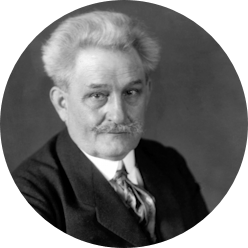
Leoš Janáček
3 de julio de 1854 - Hukvaldy, (República Checa) — 12 de agosto de 1928 - Ostrava (República Checa)
Acerca de
Early life in Moravia
Leoš Janáček (pronounced “Leoš Yanatchek”) was born in 1854 in the village of Hukvaldy, in Moravia, a historical region of Central Europe located in what is now the Czech Republic. Moravia carried a strong sense of identity and was the site of tension between the Frankish and Hungarian peoples surrounding the region until the 1st century AD. It fell under the control of its neighbors in 907, before becoming part of the Kingdom of Bohemia a century later, under the Czech Přemyslid dynasty. Three duchies were then established for the younger sons of the Dukes of Bohemia in Olomouc, Znojmo, and Brno, the future adopted home of Leoš Janáček. The region became Catholic and, a century later, came under the authority of a margrave, equivalent to a marquis. Its history is thus linked to that of Bohemia: first ruled under the Holy Roman Empire, then under the Austrian Empire. It was in this context that the composer grew up. He was the ninth child of a couple who were both teachers and musicians, and as his family soon grew by five more children, resources became limited. The young Leoš was sent to the monastery in Brno, where he was fed, housed, and educated within a strict religious and musical framework. It was there that he first discovered the treasures of his own Slavic culture which had been partially erased by centuries of Austrian rule.
Studies and discovery of Czech folklore
Janáček was only 11 years old when he left his native village to join St. Thomas Abbey in Brno. He studied organ and choral singing for five years under Pavel Křížkovský, an Augustinian monk, choirmaster, and respected composer. His teacher was a champion of Slavic culture and introduced Janáček to works by Moravian and Czech composers who remained largely unknown. Opening the doors to the musical richness of his native land of Moravia was eye-opening for Janáček; the region had been under Habsburg rule for over two centuries. It was then that he vowed to devote his life to giving the Czechs back their voice, and it was through music that this mission was realized. His musical talents did not slide under the radar: he spent two years at the Skuherský Organ School in Prague, then continued his studies in Leipzig, where he took classes with German composer Carl Reinecke among others. In 1872, he earned his diploma as a teacher and music instructor at the Teacher Training College in Brno, continuing the family tradition.
Early compositions and successes
While taking organ lessons in Prague two years later in 1874, Janáček met Antonín Dvořák. A friendship blossomed between the two musicians who shared similar views. Dvořák, who was already well-known, encouraged Janáček and critiqued his early works. He also urged him to pay attention to the inflections of spoken language, which would later on become his stylistic trademark.
Three years later, at the age of twenty-two, Janáček took over as director of the Svatopluk workers’ choir in Brno and composed his first works, including the Orchestral Suite and Šárka. In 1878, he stayed in Saint Petersburg and composed his lyric and folk-inspired Idyll for Strings. Then in 1881, after his marriage to Zdeňka Schulzová, he returned permanently to Brno and founded an organ school (the future Brno Conservatory) and devoted himself to teaching. The death of his daughter Olga in 1903 had a strong effect on him and his music. He then completed Jenůfa, his third opera, a work of poignant truth and a stylistic break. Through its dramatic force and its roots in the Czech language, Jenůfa brought Janáček into the modern era, alongside other 20th-century innovators such as Kodály, Bartók, and Stravinsky.
Leoš Janáček’s greatest works
Janáček and opera
For Janáček, opera was not only a genre but the meeting place between language, music, theater and Moravian culture. His exploration of musical drama unfolded as early as 1887 with his first opera, Šárka. The composer drew from his knowledge of folk melodies and brought the inherent musicality of Czech language to life; his attention to the natural spoken inflections of Czech gave his works a singular identity and intensity. Jenůfa, premiered in 1904, signaled a turning point in his compositional style. More somber and personal, the composer centered the opera around psychological realism and dramatic tension. He used innovative techniques such as transforming the rhythms and intonation of speech into vocal motifs, using thematic leitmotifs to introduce the characters, and heightening emotional tension with dissonant harmonies and rhythmic overlays. Following the formation of the Czechoslovak Republic in 1918, Janáček’s operatic output intensified. He had long opposed the monarchy, which manifested in his new scores: Kátia Kabanová (1919–1921) which critiques bourgeois society; Bystroušky or “The Cunning Little Vixen” (1921–1923), with which he sought to express the vitality of nature; the fantasy opera The Makropoulos Affair (1923–1925); the Glagolitic Mass (1926), based on Old Bulgarian texts; and the opera From the House of the Dead (1927–1928), based on Dostoevsky.
Sinfonietta, quartets, and other orchestral works
Alongside his operatic work, Janáček developed a deeply personal orchestral and chamber music language grounded in ostinatos (musical motifs that repeat continuously throughout a passage or a work), that can be heard in his 1926 Sinfonietta. It opens with a motif played by two euphoniums, followed by motifs from the bass trombones and timpani, and a third motif performed by nine trumpets in the upper register. In his string quartets, the String Quartet No. 1 “Kreutzer Sonata” (1923) in particular, Janáček reuses the technique by stacking motifs like Legos, similar to 21st-century computer-based electronic composition. Other works, such as the symphonic poem Taras Bulba or the Glagolitic Mass, extend this aesthetic by blending Slavic folklore with musical inventiveness. Take for example his song cycle Diary of One Who Disappeared, a song cycle for tenor, alto, and women’s choir which describes the adventures of a young farmer in love with a gypsy woman, who eventually leaves his village with her and their baby. At the same time, Janáček’s political and social commitment extended beyond opera; his sonata Z ulice (1905) pays tribute to a worker shot dead in Brno.
A musical language inspired by the Czech language
Janáček’s compositional style is rooted in the melodies and musicality of language and Czech music tradition. Always fascinated by the natural inflections and rhythms of speech, he wrote numerous critiques and theoretical reflections on the “melody of spoken language,” much like that which Mussorgsky had explored in Russia. From 1887 to 1907, Janáček worked with dialect specialist Fr. Bartoš on the collection, study, and notation of folk melodies, publishing his arrangements in 1892 and 1900. This research is reflected in his use of short musical motifs that he repeated, layered, and transformed throughout his music, much like in human speech. The result is a musical construction that seems to reproduce the patterns of real dialogue. His proclivity for this speech-style musical gesture gives his music an immediate intensity, a lively rhythm, and a sharp modernity. In his operas as well as in his instrumental works, the Czech language becomes a living part of the music.
Janáček on medici.tv
From his operas to his quartets and orchestral works, discover the best of Leoš Janáček on medici.tv, the largest streaming platform dedicated to classical music. Dive into the nuances of his musical language with beautiful 20th- and 21st-century performances on demand. Whether it’s Thomas Adès in a sublime piano recital at the Fondation Louis Vuitton, the rousing Sinfonietta by Sir Simon Rattle and the London Symphony Orchestra, or The Cunning Little Vixen performed by the great Russian soprano Elena Tsallagova, you have it all at your fingertips. Plus, delve further into the rich musical legacy of Czechia with our vast selection of works by other renowned Czech composers.
Janáček’s legacy and influence on Classical music
Janáček’s style
Leoš Janáček developed an instantly recognizable musical style based on the intonation of spoken language and the rhythms of Moravian dialects. His style approached those of his compatriots Smetana and Dvořák, to whom he dedicated his Chorus for Four Male Voices. Like them, he incorporated local folk music and regional themes into his compositions. His approach profoundly influenced Béla Bartók, who further developed the integration of folk melodies and rhythms into art music. Disdainful of Wagner, partly due to his anti-German sentiments, Janáček favored a direct and energetic musical language, far removed from Wagner’s long harmonic developments and the impressionistic melodic flights of contemporaries such as Debussy.
Janáček’s impact on Czech music
Janáček had a profound impact on Czech music and its cultural identity. His innovative style, which incorporated Moravian folklore, surprised and baffled his contemporaries. His works were often considered difficult to perform, particularly at the Prague National Theater, and while some were adapted by conductors such as Václav Talich, these adaptations strayed from the composer’s original spirit. In the 1920s, critics remained divided: while the Czech musicologist Zdeněk Nejedlý viewed his work as “amateurish,” his counterpart František Bartoš described him as a “musical eccentric.” Yet Janáček paved the way for modernism and postmodernism in Central Europe. His deep roots in Moravian culture, mastery of motifs, and innovative use of spoken language influenced an entire generation of composers, including Béla Bartók. Virtually unknown to the public half a century ago, and rediscovered in the 1960s, he is today one of the most frequently-performed composers on opera stages. His work has become a symbol of daring reclamation of cultural identity, solidifying his place among the major figures of Czech music.