


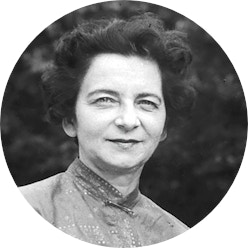
Grażyna Bacewicz
February 5, 1909 - Lodz — January 17, 1969 - Varsovia
Acerca de
Grażyna Bacewicz was one of the most important composers of the 20th century and an internationally renowned virtuoso violinist. A leading figure in postwar Polish music, she developed a personal musical language that combined modernity with neoclassical expressiveness. As the first Polish woman to establish herself as a leading composer, she was a trailblazer for many generations of artists.
Childhood and education
Birth in Łódź and education in Warsaw
Grażyna Bacewicz was born on February 5, 1909, in Łódź, a major industrial city in central Poland. She grew up in a musical family: her father, Wincenty Bacewicz, of Lithuanian origin, was a violin teacher, and her mother played the piano. Her brother Vytautas would become a composer and conductor, while her sister Wanda would also master the violin.
Grażyna began studying the violin at a very young age under her father, who provided a solid foundation in technique and discipline. She showed exceptional talent early on, both in performance and composition. In 1919, the family moved to Warsaw, the cultural capital of the Republic of Poland, recently reestablished after more than a century of partition.
Beginning in 1928, Grażyna studied at the Warsaw Conservatory, where she undertook a dual diploma: violin with Józef Jarzębski and composition with Kazimierz Sikorski. This dual focus would define her entire career. She earned her violin diploma in 1932 and her composition diploma in 1935, distinguishing herself in both disciplines through her remarkable talent and hard work. During her years at the Conservatory, she also discovered the work of Karol Szymanowski, a major figure in modern Polish music, whose influence shone through in her approach to harmony and folklore.
Further studies in Paris, including with Nadia Boulanger
In 1932–1933, thanks to a scholarship, Bacewicz traveled to Paris to further her education. The French capital was then the undisputed center of the European musical avant-garde, welcoming composers and performers from around the world. There, Grażyna studied violin with André Touret and composition with the legendary Nadia Boulanger, an extraordinary teacher who trained generations of major 20th-century composers, such as Aaron Copland, Philip Glass, and Astor Piazzolla.
Nadia Boulanger’s teaching had a profound impact on Grażyna. Structural rigor, clarity of writing, and economy of means were the name of the game and would remain hallmarks of Grażyna’s modern style. Nadia Boulanger also introduced her to French neoclassicism, an aesthetic movement embodied by Stravinsky and the composers of the Group of Six, which emphasized clarity, balance, and a return to classical forms following the excesses of expressionism.
In Paris, Grażyna was out and about discovering the latest musical trends and attending premieres of contemporary works. There she met numerous musicians and composers and built an international network that would prove invaluable throughout her career.
Violin career and early compositions
Upon her return to Poland, Bacewicz’s two degrees proved handy. As a violinist, she quickly established herself as one of the most remarkable performers of her generation. In 1936, she won first prize at the Warsaw International Violin Competition, a major achievement that opened the doors to Europe’s major concert halls. She performed as a soloist with Poland’s most prestigious orchestras and undertook numerous international tours.
Alongside her career as a concert performer, Bacewicz was already composing significant works. Her Wind Quintet (1932) and her Violin Concerto No. 1 (1937) illustrate a mastery of instrumental writing and an already-developed personal voice. These early compositions reveal the influence of French neoclassicism, but also retain a deep Polish sensibility rooted in her country’s musical traditions.
This experience as a virtuoso performer profoundly influenced her compositional style. With an intimate understanding of the violin’s technical and expressive possibilities, she composed solo parts that were highly demanding yet perfectly suited to the instrument. Her background as a violinist would be evident in all her concertos, as well as her chamber music.
War and artistic maturity
Underground activity during Nazi occupation
The invasion of Poland in September 1939 and the German occupation radically disrupted Polish cultural life. The Nazis banned all public musical activity, closed cultural institutions, and hunted down intellectuals and artists. In this dramatic context, Grażyna Bacewicz courageously continued her musical activities underground.
She actively participated in Warsaw’s underground cultural life, giving clandestine concerts in private apartments and secretly teaching the violin. These concerts represented a crucial act of cultural resistance: keeping Polish culture alive in the face of the Nazis’ determination to destroy it. Despite the daily risks of raids, arrests, and deportations, Grażyna and her colleagues did not shy away from danger and maintained an active, albeit covert, musical life.
During those horrific years, she continued to compose, notably writing her String Quartet No. 2 (1942). Composition became for her a spiritual refuge and means of preserving her artistic integrity and mental health in the face of surmounting daily horrors. The Warsaw Uprising in August 1944 and the near-total destruction of the city left a deep scar on the composer, who lost many friends and colleagues.
Postwar: a more modern musical language
After the war, Grażyna Bacewicz gradually resumed her activities. In 1945, she was appointed professor at the Łódź Conservatory, and then in 1966 at the Warsaw Academy of Music. She also continued her career as a violinist but gradually turned towards composition, as it occupied an important role in her artistic life.
Postwar Poland lived under the communist regime of the Soviet Union. Polish creatives had to follow the government-imposed socialist realism doctrine, which allowed “public-facing” music that was accessible, optimistic, and folk-inspired. This period, particularly between 1948 and 1956, forced many Polish composers into self-censorship as Western modernism was rejected as “bourgeois” and “decadent.”
Grażyna skillfully navigated this difficult period by strictly adhering to official requirements on her own terms; she preserved her artistic integrity by developing a structured neoclassical style. Her works from this period, such as her Concerto for String Orchestra (1948), combine rhythmic vitality, clarity, and lyricism—a perfect balance between pleasing the government and safeguarding her artistic ambition.
Development of a personal, rhythmic, and structured style
Beginning in the mid-1950s, with the political “thaw” following Stalin’s death, Polish cultural life underwent a gradual liberalization. Grażyna Bacewicz was then able to develop her musical language more freely. She established a compositional style characterized by several distinctive elements.
Rhythm became central to her writing. Influenced by Bartók and Stravinsky, she developed a driving pulse, repetitive rhythmic ostinatos, and irregular accents that created extraordinary tension and energy. This rhythmic dimension gives her music an immediately recognizable vitality and propulsive force. Formal structure is also essential. As a student of Nadia Boulanger, Bacewicz constructs her works as an architect would a building. Classical forms (sonata, variations, rondo) and contrapuntal techniques (fugue, canon) are the backbone to her compositions, creating a formal clarity that does not compromise complexity or expressiveness. In addition to rhythm and formal structure, her harmonic language gradually evolves toward greater modernity. While remaining tonal at its core, her music incorporates harsh dissonances, complex harmonic clusters, and modal techniques that distance it from the neoclassicism of her early works. In her later works, such as Music for Strings, Trumpet, and Percussion (1958) or Pensieri notturni (1961), she even explored serial and aleatoric techniques out of curiosity for contemporary innovations.
International recognition
From the 1950s onward, Grażyna Bacewicz enjoyed growing international recognition. Her works were performed at Europe’s most important contemporary music festivals: the Warsaw Autumn Festival (of which she was a central figure), the Darmstadt and Donaueschingen festivals, and the ISCM (International Society for Contemporary Music) festivals.
She received numerous awards and honors. In 1950, her String Quartet No. 4 won the UNESCO International Rostrum of Composers Prize. She was also awarded the Polish State Prize several times (1950, 1952, 1955), the highest honor for a composer in communist Poland. These honors attest to both national and international recognition of her artistic significance.
Bacewicz became an iconic figure of post-war Polish music, alongside Witold Lutosławski and Krzysztof Penderecki. Her status as a female composer in a still very male-dominated musical world makes her success all the more remarkable. She opened the doors for subsequent generations of female composers, proving that a woman could leave her mark on contemporary music of the highest echelon.
Despite this recognition, Grażyna Bacewicz remained a discreet and modest figure, entirely devoted to her art. A serious car accident in 1954 limited her career as a violinist, which led to her renewed devotion to composition during the final years of her life.
The music of Grażyna Bacewicz
Best-known works
Grażyna Bacewicz’s catalog comprises approximately 200 works, spanning all genres: orchestral music, concertos, chamber music, piano pieces, ballets, and incidental music. Among this vast repertoire, several works stand out in particular.
- Overture (1943): this brilliant orchestral piece, composed during the occupation, attests to Grażyna’s passion even under the worst circumstances. With remarkable rhythmic energy, it combines neoclassical clarity with expressive intensity. This work, available on medici.tv, reveals the composer’s talent for colorful orchestration as well as rigorous formal structure.
- Concerto for String Orchestra (1948): A neoclassical masterpiece, this score magnificently exploits the expressive and technical possibilities of the string orchestra. In three contrasting movements (Allegro, Andante, Vivo), the work is both highly virtuosic and intensely lyrical. The driving rhythm of the first movement, the meditative contemplation of the slow movement, and the frenzied dance of the finale make this one of Grażyna Bacewicz’s most accomplished compositions.
- Music for Strings, Trumpet, and Percussion (1958): this work marks a shift toward a harsher, more modern musical language. The contrast between the mass of strings and the percussive interventions of the trumpet and percussion creates striking dramatic contrasts. The writing is more dissonant, the rhythm more abrupt, clearly demonstrating the composer’s stylistic evolution.
- Pensieri notturni (1961) for chamber orchestra: This work, whose title means “Nighttime Thoughts,” explores a more introspective and somber atmosphere. It incorporates elements of serial technique and expressionist sounds, revealing Bacewicz’s openness to the avant-garde movements of her time.
Works for violin
Grażyna Bacewicz significantly enriched the repertoire for her instrument, thanks to her status as a virtuoso violinist. She composed seven violin concertos, each exploring different expressive and technical facets of the instrument.
- Her Violin Concertos Nos. 3, 4, and 7 are exemplary of 20th-century repertoire. The Concerto No. 3 (1948) stands out for its vitality and lyricism. Concerto No. 4 (1951) pushes virtuosity even further, demanding dazzling technique and highly subtle musicality from the soloist. Concerto No. 7 (1965), composed shortly before her death, reveals a more austere and concentrated style of writing.
- Her Sonatas for Violin and Piano are also essential milestones in the chamber music repertoire. They create a perfect dialogue between the two instruments. Sonata No. 4 (1949) is particularly remarkable for its intensity.
- The Caprices for solo violin: this piece represents a major challenge for any violinist. In the tradition of Paganini’s Caprices and Bach’s Sonatas and Partitas, these pieces explore the polyphonic and virtuosic possibilities of the solo violin. They have become landmark works in the contemporary violin repertoire, regularly performed in concerts and competitions.
Bacewicz also composed seven string quartets. Spanning her entire career (from 1938 to 1965), these quartets reflect the constant evolution of her musical language. String Quartet No. 4 (1951), awarded a prize by UNESCO, perfectly illustrates her mastery of the genre: sophisticated contrapuntal writing, rhythmic vitality, and expressiveness, unite!
She also wrote for other chamber ensembles: quintets, trios, and sonatas for various instruments. Her Piano and String Quintet (1952) and her String Trio (1945) are particularly well-regarded.
For the piano, an instrument she also played, Bacewicz composed several collections of pieces, including ten Études (1956) of great technical and musical difficulty. She also wrote several ballets, including Le Désir (1968).
Death and legacy
Grażyna Bacewicz died prematurely on January 17, 1969, in Warsaw, at the age of 59, following a heart attack. Her sudden death deprived Polish music of one of its most important figures overnight. Tragically, her international fame had just begun reaching its peak.
During her lifetime, Bacewicz enjoyed exceptional international recognition. Her works were regularly performed at the biggest European festivals, and her violin concertos made up the repertoire of the most prestigious soloists. This recognition continues to grow today: more and more orchestras and ensembles around the world are programming her compositions and sharing her musical language with new generations. Her Overture and her Concerto for String Orchestra demonstrate the timeless modernity of her writing and continue to thrill music lovers worldwide.
Bacewicz’s legacy is immense. As the first Polish woman to establish herself as a major composer, she paved the way for many female musicians to come. Her catalogue, comprising some 200 works, reflects constant creativity and continuous stylistic evolution, from the neoclassicism of her early years to the bolder experiments of her later years. She developed a personal musical language characterized by striking originality and uncommon power.