


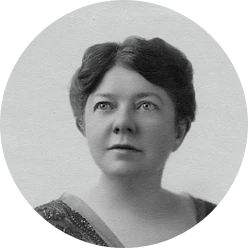
Amy Beach
5 de septiembre de 1867 - Henniker, New Hampshire — 27 de enero de 1944 - Nueva York
Acerca de
An American classical music pioneer
Who was the first American woman composer to have her symphony performed by a major orchestra? None other than Amy Beach (1867-1944), a force to reckon with—even in infancy! If we rewind a bit before her indelible mark on the history of classical music and her masterful “Gaelic” Symphony and Grand Mass, we might see a child prodigy pianist, before she established herself as a major figure in the Boston School.
A child prodigy
Childhood and discovery of her talent
Amy Marcy Cheney was born on September 5, 1867, in Henniker, New Hampshire. After a few short months in the world (twelve, to be exact), she already displayed a penchant for music: at one year old, she sang forty melodies in tune, and at two, she was already improvising harmonies on the piano. Her mother, Clara Imogene Marcy Cheney, herself a talented amateur singer, immediately recognized her daughter's exceptional gift.
The family moved to Boston in 1875, providing young Amy with an environment conducive to the development of her musical talent. It was there that she was able to develop her exceptional abilities and become the piano prodigy we know today.
Training
Amy studied piano with Ernst Perabo and Carl Baermann, but taught herself to compose by methodically analyzing the scores of the great masters. This approach allowed her to develop a personal style, nourished by her in-depth study of Bach, Beethoven, and the German Romantics.
Her mother deliberately limited her piano practice to one hour a day, fearing that Amy would burn out. Ironically, this constraint would stimulate Amy's creativity even more: she developed an extraordinary ability to work on her scores mentally, while sharpening her ear and memory in the process.
Early success as a pianist
Amy Beach played in public for the first time at the age of seven. At sixteen, she gave her first professional recital at Boston's Music Hall, performing Chopin's Concerto in G minor, among other pieces. The success was immediate: critics praised her powerful playing, remarkable technique, and exceptional musical maturity.
The following year, she performed with the Boston Symphony Orchestra and became one of the city's most renowned pianists overnight. Her interpretations of the great Romantic concertos captivated Boston audiences. At only 18, Amy established herself as a leading American pianist and aspired to a great international career.
Career and social constraints
Marriage to Dr. Beach
In 1885, Amy married Dr. Henry Harris Aubrey Beach, a renowned Boston surgeon and widower, who was 24 years her senior. At only 18 years old, her professional life was radically transformed: Dr. Beach, wealthy and influential, wanted his wife to devote herself primarily to composition rather than a career as a concert pianist. He asked her to limit her public appearances to one or two concerts a year, usually for charity purposes.
This restriction, typical of the social conventions of Victorian-era Boston high society, suddenly ended the young pianist's dream of gracing international stages. She nevertheless found an opportunity within this situation: composition was to become her specialty and claim to fame.
Major works
It was during her marriage that Amy Beach composed her most ambitious works. In 1892, she completed her Grand Mass for choir and orchestra, Op. 5, which premiered at Boston's Music Hall. This monumental work, lasting approximately 75 minutes, is impressive both in scale and architectural mastery.
Her Symphony No. 1 in E minor, Op. 32 (1894-1896), is a true orchestral feat. Inspired by traditional Irish melodies of her heritage, it became the first symphony composed and published by an American female composer. Premiered in 1896 by the Boston Symphony Orchestra under the baton of Emil Paur, the work was a resounding triumph among critics and audiences alike. Amy also composed numerous melodies, piano pieces, and works for chamber groups, demonstrating her versatility and natural lyricism.
Place within the Boston School
Amy Beach became a central figure in the Boston School (Second New England School), whose style was embodied by composers George Whitefield Chadwick, Horatio Parker, and Arthur Foote, to name a few. They sought to create authentic American classical music while drawing inspiration from European traditions, particularly Germanic ones.
Amy made a place for herself within this circle not only through her talent and aptitudes, but also through a shared vision: a desire to elevate American music to the level of the great European traditions, while incorporating elements of national folklore into her compositions.
However, her position remained unique: she had to constantly prove her legitimacy in a male-dominated environment, where women composers were generally relegated to “minor” genres such as melody or salon music.
1910: a turning point
The European era and return to the stage
The death of Dr. Beach in 1910 marked an important liberation for the 43-year-old composer. Freed from the constraints imposed by her marriage, she immediately embarked on a three-year European tour, performing as a pianist and composer and promoting her compositions in Germany, France, and Italy.
These years in Europe allowed her to reconnect with her first love—the piano. As Amy toured, she met all the greatest musicians on the continent while playing her own works to enthusiastic audiences in Leipzig, Munich, and Berlin — a string of successes that led to a new phase in her career, this time with Amy in full control of her artistic destiny.
The First World War forced her hasty return to the US in 1914, but she returned with renewed confidence and a well-established international reputation, thanks to European recognition reinforcing her stature in the United States.
Return to the US and final period
Back in the states, Amy Beach settled in New York and resumed her life as a traveling concert pianist, crisscrossing the country to give concerts and lectures. She also continued to compose numerous works for piano and that continue to enrich the American repertoire.
She spent her summers at the MacDowell artists' colony in New Hampshire, where she found the inspiration and tranquility she needed to create. Beach became a mentor to the younger generation of American composers and actively campaigned for the recognition of women in music.
Amy Beach died on December 27, 1944, in New York City at the age of 77, leaving behind more than 300 works and paving the way for a new generation of American women composers.
Impact of repertoire in the 20th and 21st centuries
After her death, Amy Beach's music fell into obscurity, a victim of the general decline in interest in American Romantic music, compounded by bias against female composers.
The second half of the 20th century, however, saw a renewed interest in her work, driven by the feminist movement and the rediscovery of unjustly neglected female composers. In the 1970s and 1980s, musicologists and performers began to unearth her scores, clarifying the richness and quality of her output to the public.
In the 21st century, Amy Beach's works are now enjoying a sort of renaissance: they are regularly recorded and performed in concert, her “Gaelic” Symphony makes up major orchestral repertoire, and her biography inspires researchers and creators. This renaissance finally solidifies her place at the head of the table of American classical music, that of a leading composer who, despite the obstacles of her time, made a lasting mark on the history of music.