David Oistrakh plays the Spring Sonata, Beethoven, Schubert, Brahms and Prokofiev
Lev Oborin (piano) - Frida Bauer (piano)

Rostropovich and Oistrakh: The War of the Titans in the Double Concerto by Brahms.

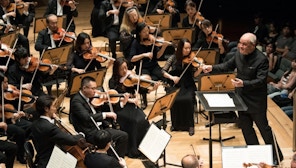
These legends of Russian music, that the Soviet regime jealously kept prisoners for so long in its white hell, are brought together for a legendary concert: Mstislav Rostropovich and David Oistrakh play the Double Concerto for Violin and Cello by Brahms under the direction of Kirill Kondrashin, another legend. Although the cellist and violinist both feature in the pantheon of musicians, their paths crossed before separating again when Rostropovich left the USSR in 1974. David Oistrakh, unlike his friend Rostropovich, remained in his country at the cost of much harassment.

Mstislav Rostropovich was born in Azerbaijan, in 1927. His mother taught him the piano and his father the cello. At the Moscow Conservatory he studies the piano, the cello, conducting and composition (his teacher is Chostakovich). He plays his first concert at fifteen, wins First Prize at the Moscow General competition and in the Prague and Budapest competitions in 1947 and 1949. In 1955, he marries Galina Vishnyevskaya, a soprano at the Bolshoi. He embarks on a dazzling career until it was halted by his death in 2007.

Death also brings a sudden end in 1974 in Amsterdam, to David Oistrakh’s career. The most fabulous violinist of the 20th century was born in Odessa in 1908. He started to work on the violin with Piotr Stolyarski, who also taught Nathan Milstein and later Oistrakh’s own son Igor. From his first recital, at sixteen in Odessa, a rumour spreads throughout the USSR and beyond its borders in spite of their being sealed shut that there is a violinist who plays like no one else, whose name is David Oistrakh… In 1937, he wins the First Prize at the Eugène Ysaÿe competition in Belgium, which opens many doors for him. Then begins a splendid career which is confined, however, to the USSR for a long time: taken hostage, he will be authorised to travel abroad only after the death of Stalin.

For these two artists, brought together in 1965 at the Royal Albert Hall in London with the Moscow Philharmonic, Brahms is more than just a common language. All three have already played his music elsewhere. As for Rostropovich and Oistrakh, they recorded the Double Concerto, but with another conductor, George Szell and another orchestra, the Cleveland Orchestra (EMI). Thanks to their unfaltering virtuosity and the prodigious intensity of their sonority, the two performers who are playing as equals give a thrilling rendition of this score.

We then hear King David in Brahms' Concerto for Violin which he recorded many times, and namely with Kondrashin. But here in London in 1958, it is with the BBC Symphonic Orchestra under the direction of Rudolf Schwartz, that we shall hear  him in the finale, an allegro giocoso performed at an amazing tempo.

Like father like son. One is led to believe that when listening to the second movement of Prokofiev's Sonata for Two Violins recorded in a studio of Le Chant du Monde in Paris in 1961 by David and Igor Oistrakh. Working closely together, the soloists’ virtuosity triumphs in this perilous allegro.


Archives :

  • Brahms Concerto for Violin and Violoncello in A minor, Op.102 "Oistrakh and Rostropovich", filmed by Brian Large, at the Royal Albert Hall, London, 9 October 1965, BBC archive.
  • Bach Concerto for 2 Violins in D minor, BWV1043, "Concert hour: David Oistrakh", filmed by Antony Craxton, at the Salle Pleyel, Paris, 24 October 1958, BBC archive.
  • "La musique et la vie", INA archive by Roger Benamou, 1961.

David Oistrakh violin
Lev Oborin piano
Frida Bauer piano

Movie director : Philippe Truffault
Collection : Classic Archive
Music genre : Recitals and chamber music
Musical form : Sonata

Duration : 51 min
Location : Royal Albert Hall (London, Great Britain)
Recording date : 1962, 1965
Production date : 2000
Production : © Ideale Audience / Img Artistes